Showing posts with label Grief. Show all posts

Friday, January 7, 2022

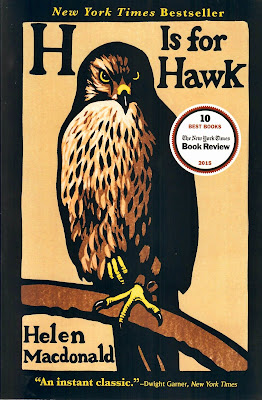
H Is For Hawk


In these days of climate change and wholesale destruction of nature, we hang all hopes for the future on nature’s resilience.  That resilience is the theme underlying Helen Macdonald’s memoir H Is For Hawk (Grove Press, 2014).  Hers is a triangulated story shifting from her father’s death to the life of Arthurian legend writer T.H. White to Macdonald’s training of Mabel the goshawk, the medium-large raptor Accipiter gentilis of the title.  If these seem like strange bedfellows, Macdonald makes these transitions smoothly and by the end of the book, weaves a story of personal redemption and self-discovery that is both wise and profound.

T. H. White also wrote a book about raising and training a goshawk, and Macdonald turns to the celebrated author’s book as a guide for her own journey with Mabel.  He was not as prepared as Macdonald, and therefore his account is more fraught with difficulty and disappointment.  Yet he is a touchstone for Macdonald, a connection to an experience with an animal who has as much to teach her trainer as her trainer has to understand this predatory bird.  With a goshawk, however, there is no taming her nature; Macdonald, with great difficulty, simply trains the bird to follow her own instincts as a hunter of prey, and human and hawk learn to work as a unit on the hunt.

Macdonald’s father was a photojournalist who died in 2007.  She recounts his passing while on the job, and how she had to go with family members to pick up his belongings and find his car, which had been towed away when he did not return to pick it up while covering his final story.  Macdonald was very close to him, and the loss is almost overwhelming.  Part of her own training is to learn to live with loss and grief.  She recounts how her father taught her patience as the most important virtue.  He tells her that one must be willing to stay still and wait for her moment, much like a piece of reindeer moss can survive “just about anything the world throws at it” and remain resilient.  It is ironic that she finds herself staring at the moss when her mother informs her of her father’s passing.

The life of an Astringer—a solitary trainer of goshawks and sparrowhawks—is a lonely one, and Macdonald describes her daily life and routines with Mabel in poetic and deeply harmonic language.  The setting of the book is the Brecklands, a place known as the broken lands, and the area lives up to its name.  She clings to the words of Marianne Moore:  “The cure for loneliness is solitude.”  She tells us she has learned to hold tight and survive, much like the security of the jesses, leather straps that bind the hawk to the Astringer.  Her twin brother did not survive the difficult birth that brought Macdonald into the world.
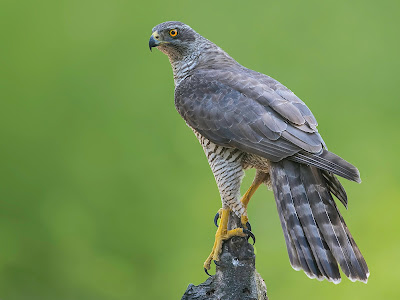


Macdonald is so good at distilling the wisdom she absorbs from training Mabel.  She tells us there are two things she has learned about training hawks:  the Astringer must learn to become invisible, and the way to a hawk’s heart is through positive reinforcement with food.  Hawks are not social animals like dogs or horses.  They are predators, and their predatory nature is bred in their bones.  She equates training goshawks with “white-knuckle jobs” as described by her father.  These are dangerous journalism assignments.  Her father’s defense against the fear is to “look through the viewfinder” and stop being involved.  Instead, become the witness.  “All that exists is a square of finely ground glass and the world seen through it,” he tells her.  His advice in stressful, dangerous situations is to be mindful of “exposure and depth of field and getting the shot you hope for.”  Macdonald sees her father’s work in each photograph as “a record, a testament, a bulwark against forgetting, against nothingness, against death.”
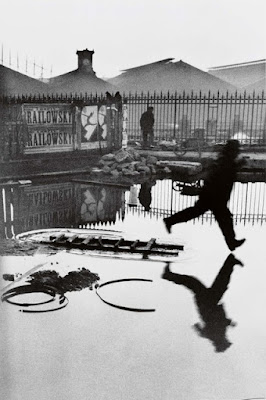
Henri Cartier-Bresson
Rooted in her father’s philosophy is one that Macdonald also discovers in nature when training Mabel.  The world is forever; we are only a blink in its course.  Macdonald references Henri Cartier-Bresson, the great French street photographer, and his photographs of a decisive moment.  A good photograph means being open to all life offers and in an intuitive moment, click the shutter to capture.  If one misses the moment, it is gone forever.  Our lesson is to live in that moment—no past, no future, only the here and now.

Throughout the book, Macdonald’s writing is poetic and beautiful.  She writes:  “There is a time in life when you expect the world to be always full of new things.  And then comes a day when you realize that is not how it will be at all.  You see that life will become a thing made of holes.  Absences.  Losses.  Things that were there and are no longer.  And you realize, too, that you have to grow around and between the gaps, though you can put your hand out to where things were and feel that tense, shining dullness of the space where the memories are.”

 She also does not neglect the mythological elements of hawks and falcons, one that has played out over millennia:  in ancient shamanic traditions in Eurasian cultures, “hawks and falcons were seen as messengers between this world and the next.”  Mabel comes into Helen Macdonald’s life right at a time of need, and in working with this intense and intelligent animal, she finds peace and purpose in her life.  She illuminates a culture that most of us never experience:  training a fierce and intense goshawk to hunt with her human counterpart.  In the end, Macdonald comes to understand the overwhelming grief and loss inherent in this life.  Her story is extraordinary and extraordinarily beautiful.


Friday, November 19, 2021

Dear Memory


In this haunting and luminous work, Victoria Chang gives us a series of epistles and found collages to address the melancholic remembrances of things past.  Dear Memory:  Letters on Writing, Silence, and Grief (Milkweed Editions, 2021) is an elegy and lament for the dead and gone:  her ancestors, her teachers, and friends.  She quotes poet Mary Jo Bang:  “What is an elegy but the attempt / To rebreathe life / Into what the gone once was…”  The book is filled with light and shadow, the pneuma of humanity and the human condition.  More poetry than prose, the book is a connotative tour de force of what it means to be alive and to live with the breath of memory and regret.

Chang is a poet, a teacher, and program chair in the Creative Writing Department at Antioch University.  She believes in writing that puts language at risk, allowing words to build into something beyond the self.  She asks:  “Can I be the hawk and the storm that tries to murder the hawk?”  The question is fraught with danger.  She confronts and sifts through memory and goes directly to how our lives often play out in the blood, the DNA of who we are, and what we do with our brief time in this human epoch.  She documents the sorrow and grace of her existence, both visually and in words.  “Perhaps something never happened if no one remembers it,” she writes.  “Perhaps there’s no truth.  Just memory and words.”

Coupled with her words are these haunting collages, many composed of documents and paper fragments of her past.  She writes dialogue with her mother directly in the spaces on each picture as if conducting an interview.  Other collages are family photographs, some with faces etched out as if demonstrating how they dwell in the shadows of her history.  Collectively, the collages tell the parallel story; they weave into and out of the word-epistles.  The letters and the collages are rare jewels.  They both enhance and magnify the threads that bind the story together from word to image.  Her poet’s sense of the spare and lyrical is ever-present in the art and the words.

Often, Chang’s language stuns us with its beauty and insight.  “Maybe our desire for the past grows after the decay of our present, she writes.  “When the present is more than we can hold, it turns into history.  And the future turns into water.  The water between your countries.”  It is this water that her family journeyed over to find their destiny.  Chang feels her place in America, but the book she creates also pays homage to those who made that journey and who, in turn, made her a unique part of a new nation, a new home.  This is an immigrant story, and Chang pays artful attention to this most American of ideas.  She wonders if memory is different for immigrants, “for people who leave so much behind.  Memory isn’t something that blooms but something that bleeds internally, something to be stopped.  Memory hides because it isn’t useful.”  It is clearly the calling of the poet-artist to bring the memory forward, to shine light, muted or harsh, to illuminate the darkness of experience, of grief, of sorrow, of regret.

There are gaps in her family history that she does not fully understand and wants to explore.  Memories, dreams, reflections, all kaleidoscope together in the form of questions she did not ask at the time, or did not find the answers to later.  “The things that didn’t matter at the time are often the most urgent questions after someone has died,” she writes.

She devotes much to a discussion of silence and grief.  What is not said speaks volumes.  It is silence that cannot be undone, and in that way, Chang tells us, it is like death.  The story ends when no one remembers the words, the people in the photographs, the significance of things.  But the dead are wise.  They know things.  “By the time we die,” Chang writes, “we know everything we need to know.”  Those of us left behind must wonder what the dead have taken with them.  It is up to the living to remember the strands of the story and continue it.

Chang circles back to writing at the end.  She recognizes that dragging a “not-yet-ready memory” into the light is often painful.  It is difficult and lacerating.  “More and more,” she writes, “I think writing is not a choice but an act of patience.  An act of listening to silence, into silence.”  It is in silence that, paradoxically, we hear voices.  In silence, we communicate with the dead, with our own souls, and where the world is still enough to hear our own breath rushing in and out of our lives.  It takes bravery and courage to listen to the silences and become aware.  Victoria Chang models such heroism for us, and the result is a shimmering and beautiful book.


Friday, October 1, 2021

A Friday Night Return

AP Photo / Bloomsburg Press Enterprise, Jimmy May


Years ago, there were Friday night football games, the marching band, cheerleaders, the smoke from hamburgers grilling out back of the snack bar, and that was the end to another busy week in the fall of the year.  Now, I hear echoes through the trees of the marching band and the roar of the crowd at my old high school just a few blocks away from my apartment.  High school football and smoke in the air:  nothing changes but everything.

“Notes on books, culture, and the life of the mind,” reads my blog tagline.  Well, I’ve been overwhelmed by all the life lessons lately, frantically scribbling away in journals and notebooks but not for publication.  What is this life?  What will happen next?  I could only ask my notebooks.  I wanted answers, and until I found them, I did not feel I had the courage to speak.  I had forgotten the prime directive of my own teaching philosophy:  the questions are more important than the answers.  The answers will always exist, but if one does not ask the right questions, the answers will never be found.

The last few years have been a crisis of faith for everyone.  Most of us were left to ponder:  where are we going?  Is the spirit of America dead?  What if we discover that the spirit has always been dead, that “all men are created equal” are just pretty words?  Maybe there is no equality and no justice, no liberty and no allowance for freedom.  Or, that we are slaves to our fears, our prejudices, our narcissism.  To the immigrant yearning for a better life we offer only the whip or the gun.  We sow the seeds of violence and celebrate the bloody harvest.  We are unwilling to reach out a hand to those in despair.  That is what we have become, a nation armed to the teeth against the Other.  A people too selfish and narcissistic to see we are all dreamers; we are all here in search of a better life.

We should be striving for a more perfect union.  Perfection may be unattainable, but like most sentences, in that one, the verb is the heart of the matter:  striving.  To paraphrase King, we may not get there in our lifetimes.  We may never get there, but we continue striving.  Always.

“I’ve seen fire and I’ve seen rain,” goes the lament.  Depression is the black dog that follows us home and threatens never to leave.  Anxiety wakes us in the middle of the night and disturbs our vague and restless dreams.  “I grow old…I grow old.”  We do and we are.  We are old before our time.  “Would it have been worth it after all, would it have been worthwhile, after the sunsets and the dooryards and the sprinkled streets, after the novels; after the tea cups, after the skirts that trail along the floor—and this, and so much more?”

America is a colder place:  700,000 of us are gone from this autumnal world.  Where do we go from here?  The only answer, the best answer I have, is onward, while the ghosts flow in and around each of us and fall behind.  We try to carry some essence of them with us but it is like trying to transport the ocean to the desert with only our cupped hands.  It is too much to carry.  It is a futile enterprise on the way down to our own dusty deaths.

Yet, there is hope.  There is life and there is what remains.  We are more resilient than we know.

At the dawn of the new year, my grand-niece was born.  Charlotte Ileana, named for that patron saint of English literature, Charlotte Bronte.  I have watched Charlie discover her world.  In her face, I see my niece, her husband, his family, and my lost father-in-law.  She has not dared to eat a peach, as Eliot writes in his poem, but she did try mango the other night with hilarious results.  Mango and the world are her frontiers in these early days of her life.

So it is time to pick up that thread that connects us.  The thread always seems ready to snap.  Our humanity is always in danger of fading away.  But this is life and this is us, and we are striving to bring about that most American of dreams:  a more perfect union.  That is the only struggle that matters now.

This is a time for wonder:  “Do I dare disturb the universe?”  We have no choice because we are alive and among the living.

As for the blog, look for more notes on books, culture, and the life of the mind.  If I find a few answers in the smoke and fire of daily life, I’ll post those too.  “Let us go then, you and I, when the evening is spread out against the sky…”  Onward!


Wednesday, September 30, 2020

Poor Banished Children of Eve


It is the dusky shadows of an ancient September.  My grandmother sits on the porch of her house, reciting the rosary in monotonous, sepia tones:

“Hail Holy Queen, Mother of Mercy, our life, our sweetness, and our hope.  To thee we cry, poor banished children of Eve…”

I was often pulled into this ritual.  She would hand me one of her spare strings of beads, and I would take my seat in the autumnal twilight, sinking into the recitation, the circular rhythm.  In the span of my childhood, I went from not understanding the words I breathed, to comprehending their significance, to finding them anachronistic.  Yet, there is a comfort in prayer, a reassuring spirit in following through:

“Glory be to the father, and to the son, and to the Holy Spirit.  As it was in the beginning, is now, and ever shall be, world without end, Amen.”

Except worlds do end, and begin again.

My grandmother is gone.  The house is unrecognizable, altered by another owner.  And I am middle-aged.  The ritual remains lodged in the shrouds of memory.  Yet, it is once again September.  In September, we use to go to play at my grandmother’s house after school.  That, too, is a strand of memory broken.

Our rituals have all been broken.  This only adds to our feeling that the world has turned upside down.  We do not leave our homes now.  We avoid contact and protect ourselves.  My ritual is to rise in the morning, go to my desk, bring up a student’s face on my screen, and work with her for an hour on her essay.  Later, I will pull up another face to discuss her struggles in her classes, the learning strategies and work-arounds that will help her get back on track.

Despite all our devices, our methods of communication allowing one person to see another in pixels on a screen, we are lonely still.  It feels as if the world is ending, but as my friend, William Michaelian, wrote recently:

“The end of the world is a strange and beautiful place. It keeps growing, and it keeps ending. And as it ends, it gives birth to countless new beginnings.”

To do this, we may have to let go of cherished rituals:  family dinners, baseball games, the rhythms and milestones of the workweek, the long walk at twilight.  We must adapt and change our colors, and recognize that we see the world differently now, and there will be new rituals to embrace.  “And as it ends, it gives birth to countless new beginnings.”

I do not pray anymore.  Mumbling words without the strength of conviction is an exhausted ritual I can do without.  I love silence.  If she were still alive, I would gladly go sit on my grandmother’s porch with her.  I would tell her how the world has changed.  She would tell me the torch has been passed.  And then she would say her prayers while I take in the gloaming in silence, feeling the wind on my face.

I have been dreaming of her lately.  Or, I should say, in the dreams, she is dead as she is in real life, but I dream of her house.  I am there again.  The house is empty, but the same as when I last was there.  I am responsible for repairing and renovating it, for keeping it preserved.  There are the gardens, the fruit trees, the lawns, the two-story house itself.  I rise every morning at dawn to walk the property, a single house on three connected lots.  I water the vegetables and flowers, mow the grass, prune the trees and shrubs in season.  If there is something to repair, the materials appear, and I can put it right again.  There are no other people in this dream.  I am the sole survivor of some colossal ending.  It is strange and discomforting.  I do not leave the property, and a ten-foot wooden fence protects the place from intruders.  I can see only the sky above.  Nearby houses are shadowy and undefined.  What kind of dream is this?  Purgatory?  Heaven?  When does solitude become loneliness?

There is no one left to perform the ritual, no mumbled prayers to Mary, the Mother of God.  I am not interested in continuing the nightly prayer.  I am more interested in the Orthodox Jew, swaying back and forth in prayer.  I am more interested in the Buddhist, in the lotus position, humming, gone into another plane of existence.  I am interested in the Muslim, on his knees, facing Mecca, which may be a million miles away on the other side of the globe, yet he is tethered to it by a strong and indestructible fiber of the heart.  Finally, I am the one who spans the distance and lands somewhere between agnostic and atheist.  I know the world is a sacred place.  I know that divinity lives in all things.  And I know that we do not end.  We are transfigured at the moment of death—we become light and air.

So I am thinking of past Septembers.  We just observed Yom Kippur, the Day of Atonement, a moment we should all reflect upon, not just our friends in Judaism.  The world needs to recognize the pain and suffering we cause each other, the way we are hell-bent on destroying who we are and what we have built with our own hands as well as the pulsating Earth beneath us.

My grandmother, in an afterlife of her own construction, is probably sitting on her porch in some other unreachable dimension, mumbling her prayers and letting the beads slip over her fingers, keeping count of decades and prayers.  That is her path now.

I stay up late into the warm fall night, remembering all of it, the way we live, the poor banished children of Eve.


Tuesday, August 11, 2020

"Memorial Drive" by Natasha Trethewey

In childhood, begin our stories, and those stories influence all the chapters to come in the great epic novel of our lives.  Natasha Trethewey, in her book, Memorial Drive:  A Daughter’s Memoir (Ecco/HarperCollins, 2020) dares to grapple with the murder of her mother and the way that horrific event propels her into adulthood.  Trethewey, a Pulitzer Prize winner for poetry in 2007, offers us a spare and elegiac tracing through the shards of memory.  In the end, we are left with the potent realization that what is missing always remains with us, including the dead.

Trethewey brackets her story the question:  “Do you know what it means to have a wound that never heals?”  Born in Gulfport, Mississippi, she spends her childhood moving from her birthplace to Atlanta, Georgia, and back again as her parents’ marriage falls apart and her mother remarries a Vietnam vet named Joel.  After the second marriage, Natasha welcomes the birth of a half-brother, but there is an ominous shadow over their lives.  Joel suffers from PTSD and the after-effects of his time in the military.  His behavior is strange, violent, and belligerent; he picks on Natasha and harasses her when her mother is at work.  This malevolent darkness awakens her to the power of story and lays the foundation for her future as a writer even as it spells tragedy for her mother and this new cobbled-together family.  Trethewey writes, “I need now to make sense of our history, to understand the tragic course upon which my mother’s life was set and the way my own life has been shaped by that legacy.”

Language offers redemption.  She immerses herself in symbol and metaphor, the poetics of living in extremis.  She rages in her diary, knowing Joel is reading it.  She loses herself in story, checking out books from the library, as many as she can, to lose herself in reading.  One metaphor that she uses to convey the losses she suffers is the phantom pain an amputee experiences.  It is the figurative language of compartmentalization—escaping into story from the force that threatens to overwhelm her.

She focuses on a belt made of bullets that her mother wears, a strange accessory, ironic in light of her eventual death.  The bullet belt sticks in Trethewey’s mind, a harbinger of things to come where she will have a front row seat at her family’s apocalyptic moment when bullets shatter their lives.  It is again a powerful symbol.  She describes the belt as “cold metal brushing my hand,” and that her mother’s body was literally “ringed in the objects of her undoing.”

Trethewey analyzes what she sees as her own culpability in her mother’s fate.  Joel shows up at a high school football game where she is a cheerleader.  He sits in the stands directly in front of where she is cheering on the track.  She attempts to make nice with him, smiling and waving.  She would not find out until later that he had a gun in his pocket and had decided to kill her in front of the crowd to get back at her mother, but he lost his nerve.  In retrospect, in that moment of smiling and waving to him, she feels she escaped her own murder but sealed her mother’s fate.  Upon reflection, Trethewey comes to see her desperate attempts to placate the abuser, Joel, as a “kind of magical thinking,” believing that she can somehow mitigate the anger and irrational violence of her stepfather and prevent tragedy from happening.  In the transcriptions of Joel and her mother’s final phone calls, it is clear he plans to follow through on his threats.  He uses the textbook language.  Even the art he creates in the final days is prescient.  Trethewey describes it as “black negative space surrounding a misshapen bird that may as well have been the symbol of his soul.”

Natasha, the child, hears the unbearable sounds of her mother being beaten at night.  She wants to protect her, to jump in front of her when the bullet arrives.  Trethewey, the adult, realizes the futility of this:  “Look at you.  Even now you think you can write yourself away from that girl you were, distance yourself in the second person, as if you weren’t the one to whom any of this happened.”  Writing is the only way through the maelstrom of her past.  She longs to find peace with her unique “geography of fate.”  That wound, again, cannot be healed.  In the end, she realizes the story is the only “arc and meaning of our lives.”  She says, “To survive trauma, one must be able to tell a story about it.”  Story redeems; it converts experience into understanding and acceptance.

This is a searing, painful examination of life and love and murder played out in the shadowlands of the American south.  Natasha Trethewey spares us nothing.  She brings us in close to probe that wound that never heals, the one that continues to burn through the years, leaving only phantom pain and memory to carry us forward.


Thursday, July 30, 2020

Fault Lines and Earthquakes


We were awakened this morning by a 4.2 earthquake centered about ten miles from our apartment.  No damage, just jangled nerves as we leapt out of bed and went to check our home seismograph more commonly known as the light fixture over the dining room table.  Swaying, it was, confirming that we were not dreaming.

“This, too?” I mumbled to myself.

This morning, I watched the funeral of John Lewis, beloved Civil Rights icon and congressman.  Speaker after speaker reminded us that democracy is a work in progress.  We who live in this country should always be striving to “form a more perfect union.”  The wording is clear:  we strive to form a more perfect union, meaning that perfection will never be achieved.  It is the eternal struggle of democracy to fight to be better, more inclusive, more just.  That is the nature of things.

Struggling to form a more perfect union means that like all Californians, we live with upheaval.  We tolerate the earthquakes because we live in this state, and earthquakes are a fact of life.  We live in this country, and therefore, equality, social justice, and equal representation under the law are achieved only at a cost.  We will never erase a hateful heart or one bent on violence and oppression.  We must be willing, as John Lewis was, to take the blows and wounds in the fight to fulfill the promise of the democratic, multi-cultural collage that is America.

The war for justice never ends.

However, the war is beautiful in its heroism.  The friction brings glory and truth and pain and suffering to the forefront.  Nature mirrors this.  The Grand Canyon represents a war between water and stone.  It has lasted for millennia.  What remains in that perpetual conflict is a thing of beauty and a joy forever.  It is the earth showing us that change is not always easy and never complete.  It simply is, always.

What is more explicit in this natural wonder is the power of a malleable substance—water—to wear away stone that seems impervious to all forces acting upon it.  Yet, here is water carving its way down the canyon and creating this beautiful cataclysm of time and substance.  We are the water; the injustice is the stone.  Water will drip and flow around the rock.  Water will diminish in the heat of the desert.  Water is soft and splashy and mutable—liquid, steam, ice.  But water prevails because it is patient and consistent.  Given time and tide, water will bore right through the rock.

So be like water.

We survive earthquakes but they are a part of our geology.  We are never done with them as we will never be a perfect society or a flawless world.  There will always be those who threaten to upend our rights, throw us into prison, bring down the club upon our skulls.  We go on.  We stand witness to the “huddled masses yearning to breathe free” and we fight for human rights and the end to racism, environmental destruction, oppression, discrimination, violence, and the rape and pillage of our world.

Today, we said goodbye to a righteous man.  We will not easily replace him as an advocate for “good trouble.”  In the same breath, we have been threatened by a man who would destroy our civilization, our culture, our tired and poor.  He is trying to stop anyone who dares to lift a “lamp beside the golden door” to sanctuary and opportunity, hallmarks of the American Dream.

We will fight on with words and bayonets.  We will strive to create a more perfect world. We will hold fast to the earth as it heaves and bucks.  And we will survive.  We will flourish.

We will miss you, John Lewis.  However, you did your part, and may angels sing you to your rest.  Now, the fight goes on, and it is up to us to carry the torch.