Showing posts with label literature. Show all posts

Friday, January 7, 2022

H Is For Hawk


In these days of climate change and wholesale destruction of nature, we hang all hopes for the future on nature’s resilience.  That resilience is the theme underlying Helen Macdonald’s memoir H Is For Hawk (Grove Press, 2014).  Hers is a triangulated story shifting from her father’s death to the life of Arthurian legend writer T.H. White to Macdonald’s training of Mabel the goshawk, the medium-large raptor Accipiter gentilis of the title.  If these seem like strange bedfellows, Macdonald makes these transitions smoothly and by the end of the book, weaves a story of personal redemption and self-discovery that is both wise and profound.

T. H. White also wrote a book about raising and training a goshawk, and Macdonald turns to the celebrated author’s book as a guide for her own journey with Mabel.  He was not as prepared as Macdonald, and therefore his account is more fraught with difficulty and disappointment.  Yet he is a touchstone for Macdonald, a connection to an experience with an animal who has as much to teach her trainer as her trainer has to understand this predatory bird.  With a goshawk, however, there is no taming her nature; Macdonald, with great difficulty, simply trains the bird to follow her own instincts as a hunter of prey, and human and hawk learn to work as a unit on the hunt.

Macdonald’s father was a photojournalist who died in 2007.  She recounts his passing while on the job, and how she had to go with family members to pick up his belongings and find his car, which had been towed away when he did not return to pick it up while covering his final story.  Macdonald was very close to him, and the loss is almost overwhelming.  Part of her own training is to learn to live with loss and grief.  She recounts how her father taught her patience as the most important virtue.  He tells her that one must be willing to stay still and wait for her moment, much like a piece of reindeer moss can survive “just about anything the world throws at it” and remain resilient.  It is ironic that she finds herself staring at the moss when her mother informs her of her father’s passing.

The life of an Astringer—a solitary trainer of goshawks and sparrowhawks—is a lonely one, and Macdonald describes her daily life and routines with Mabel in poetic and deeply harmonic language.  The setting of the book is the Brecklands, a place known as the broken lands, and the area lives up to its name.  She clings to the words of Marianne Moore:  “The cure for loneliness is solitude.”  She tells us she has learned to hold tight and survive, much like the security of the jesses, leather straps that bind the hawk to the Astringer.  Her twin brother did not survive the difficult birth that brought Macdonald into the world.
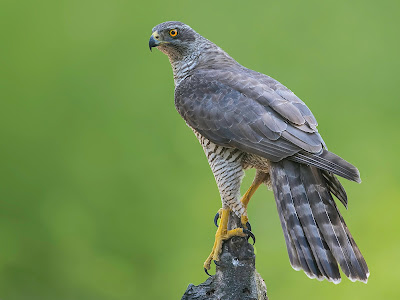


Macdonald is so good at distilling the wisdom she absorbs from training Mabel.  She tells us there are two things she has learned about training hawks:  the Astringer must learn to become invisible, and the way to a hawk’s heart is through positive reinforcement with food.  Hawks are not social animals like dogs or horses.  They are predators, and their predatory nature is bred in their bones.  She equates training goshawks with “white-knuckle jobs” as described by her father.  These are dangerous journalism assignments.  Her father’s defense against the fear is to “look through the viewfinder” and stop being involved.  Instead, become the witness.  “All that exists is a square of finely ground glass and the world seen through it,” he tells her.  His advice in stressful, dangerous situations is to be mindful of “exposure and depth of field and getting the shot you hope for.”  Macdonald sees her father’s work in each photograph as “a record, a testament, a bulwark against forgetting, against nothingness, against death.”
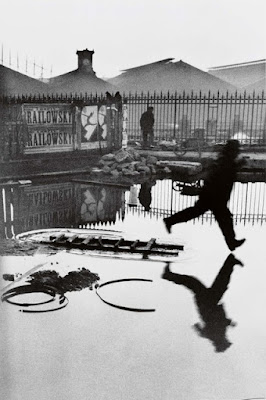
Henri Cartier-Bresson
Rooted in her father’s philosophy is one that Macdonald also discovers in nature when training Mabel.  The world is forever; we are only a blink in its course.  Macdonald references Henri Cartier-Bresson, the great French street photographer, and his photographs of a decisive moment.  A good photograph means being open to all life offers and in an intuitive moment, click the shutter to capture.  If one misses the moment, it is gone forever.  Our lesson is to live in that moment—no past, no future, only the here and now.

Throughout the book, Macdonald’s writing is poetic and beautiful.  She writes:  “There is a time in life when you expect the world to be always full of new things.  And then comes a day when you realize that is not how it will be at all.  You see that life will become a thing made of holes.  Absences.  Losses.  Things that were there and are no longer.  And you realize, too, that you have to grow around and between the gaps, though you can put your hand out to where things were and feel that tense, shining dullness of the space where the memories are.”

 She also does not neglect the mythological elements of hawks and falcons, one that has played out over millennia:  in ancient shamanic traditions in Eurasian cultures, “hawks and falcons were seen as messengers between this world and the next.”  Mabel comes into Helen Macdonald’s life right at a time of need, and in working with this intense and intelligent animal, she finds peace and purpose in her life.  She illuminates a culture that most of us never experience:  training a fierce and intense goshawk to hunt with her human counterpart.  In the end, Macdonald comes to understand the overwhelming grief and loss inherent in this life.  Her story is extraordinary and extraordinarily beautiful.


Sunday, November 7, 2021

Burning Boy

What makes American writer Stephen Crane unique, according to Paul Auster, author of Burning Boy: The Life and Work of Stephen Crane (Henry Holt and Company, 2021), is the cinematic nature of his art.  It is “as if each sentence were a small work in itself, a separate photograph or drawing to be contemplated for a moment before the next one replaces it.”  This is “what one might call a cinematic style before the language of movies had been invented.”  This is not a style found just in Crane’s masterpiece, The Red Badge of Courage; his cinematic style can be found throughout his work.

Auster attributes this to the way Crane saw his world.  “Every sound triggered off a color in his mind,” he writes, and he found it strange that others did not have a similar reaction.  Sounds could be colors, but he also found color in emotions and “various shades of thought.  These responses were felt deep within and absorbed into Crane’s body, which was the site of a constant inrush of raw sensation, and not only can traces of these collisions between the outside and the inside be found all over his work, it seems perfectly plausible that a man with such a finely tuned nervous system should have been known for his darting, restless, inconstant personality.”

Crane left behind no journals or notebooks to let us know what he was thinking and feeling when he wrote and lived.  Everything comes down to his writing—his journalism, novels, and most especially, his short fiction, albeit it an original story or a retelling of his life experiences.  So Auster relies on the letters, journals, recollections and unpublished memoirs of others to fill in the considerable gaps in Crane’s life.  He also devotes a sizable portion of the real estate in this comprehensive and exhaustively researched book to lit-crit analysis and evaluation of the writer’s oeuvre.  His audience is “the invisible army of so-called general readers, that is, people who are not academics or writers themselves, the same people who still take pleasure in reading old standbys such as Melville and Whitman…”  His concern is that Crane is no longer read by anyone anymore.  Crane has a place in the American canon, and although he is best known for The Red Badge of Courage and Maggie:  A Girl of the Streets, Auster discusses the full range of Crane’s work, including his startlingly dark and beautiful poetry.

Crane also died young of tuberculosis and other ailments that robbed him of life at the age of 28.  “When an artist dies at such a young age,” Auster writes, “it is impossible not to wonder what kind of work that artist would have done later in life.”  Auster convinces the reader that Crane packed a full life into his years, but they were not always pleasant.  He battled constant financial jeopardy, and he wrote much of his work in a frantic effort to stave off the bill collectors and debts he accumulated.

Stephen Crane was born into a large family of fourteen brothers and sisters.  His hallmark traits were stubbornness and absolute truthfulness.  He did not take to college and found “Humanity was a much more interesting study.”  He read voraciously on his own and worked as a journalist to get more experience in the world and to practice his craft.  Auster sums up his style this way:  “Crane’s obsessions and stylistic trademarks:  an abundant use of color imagery to express both emotional states and sensory experiences, a gift for unexpected metaphors and jolting similes, an animistic view of the natural world (the trees, stones, and plants in the woods are alive), a dispassionate approach to character that posits the isolation of the individual in the face of an indifferent universe, and a close scrutiny of the metaphysics of fear, the same fear that runs through every paragraph of The Red Badge of Courage…”  He did his best work when “he was afraid, trembling in his bones and scarcely aware of what he was doing—or why he was doing it.”

When writing a biography, one can become an apologist for the subject’s bad behavior.  Auster does a little of this with Crane.  He claims that Crane did not “hate people who were not like himself.  He simply did not understand them, and rather than make the effort to penetrate their thinking or attempt to see the world through their eyes, he stood back and watched, either with indifference (immigrants) or fascination (Indians) but nearly always with a sense that the person he was looking at was alien to him, an inscrutable Other.”  One would expect Crane to observe and report, the twin responsibilities of a journalist.  He was also a product of his time.

Crane was a man with a strong creed to which he swore absolute fidelity:  “we are the most successful in art when we approach the nearest to nature and truth.”  Auster does an excellent job of getting to Crane’s “nature and truth,” even if the windows into the interior were limited to the work and his letters.  He recognizes Crane’s obsession with death and dying.  He offers up the central events of Crane’s life, especially when he nearly drowned off the coast of Florida, an experience that became the basis for his short story, “The Open Boat.”  We learn of his consorting with prostitutes and his battles to be with his companion, Cora.  He walks us through the final days as the writer slipped away, giving us his most poignant last words:  “I leave here gentle, seeking to do good, firm, resolute, impregnable.”

Paul Auster demonstrates the value and necessity of Stephen Crane’s work.  His writer’s philosophy to “strip it to the bone…” and “say as much as you can by saying as little as you can,” resonates today.  However, Auster also reflects on Crane’s larger importance to our culture as he writes the last sentences of this book in the early days of 2020:  “[Crane’s] books are being forgotten again.  It is a dark time for America, a dark time everywhere, and with so much happening to erode our certainties about who we are and where we are going next, perhaps the moment has come to dig the burning boy out of his grave and start remembering him again.  The prose still crackles, the eye still cuts, the work still stings.  Does any of this matter to us anymore?  If it does, and one can only hope it does, attention must be paid.”

Wednesday, October 28, 2020

Living With Fear and Uncertainty


“Knowledge is the knowing that we cannot know.”

Ralph Waldo Emerson--“Montaigne; or, the Skeptic”


Ralph Waldo Emerson would have made a great Zen poet.  He lived through the Civil War, a time when America’s future was anything but certain.  He also survived the early deaths of his father and his first wife.

As a student, he showed little promise and graduated near the bottom of his class at Harvard Divinity School.  He was described at the time as “tubercular, restless, and already questioning the religion” he was studying.  It was after his wife’s death that he quit the ministry and pursued his life of the mind.

The rest, as they say, is history.  His collected writings run to forty volumes, and he is considered the father of Transcendentalism and American philosophy.

Sometimes, the smartest thing to do is admit your own ignorance.  Begin in humility to learn, to study, to be open to the world.  As Emerson can attest, it is a beautiful life in all its sadness and joy.


“When inspiration has become hidden, when we feel ready to give up, this is the time when healing can be found in the tenderness of pain itself…A warrior accepts that we can never know what will happen to us next…But the truth is that we can never avoid uncertainty.  This not knowing is part of the adventure.  It is also what makes us afraid.”

Pema Chodron--Comfortable With Uncertainty (Shambhala, 2003)


Chodron is a rarity:  an American Buddhist nun.  She lives and teaches in the cold and beautiful isolation of Cape Breton, Nova Scotia.

Our journey in life is always fraught with uncertainty.  Push on and persevere; since not knowing is our constant companion, let go of fear and trepidation.  It is in the midst of uncertainty that the interesting stuff happens.  See this period of change as an opportunity to grow and find wisdom.  Never fear the better you to come.


“We fear many things.  We fear illness and death.  We fear losing our job or falling into poverty.  We fear change—a new career, a new home, a new marriage.  We may fear being alone, or we may fear other people.  And then there is the fear of not being accepted by others—by our families and friends, our colleagues and neighbors, by society at large…fear is a tremendous and complicated power.  It is silent yet devastating, leading to anxiety and ultimately, depression.  When you are consumed by fear, your judgment is distorted; you become frozen by doubt, unable to make the simplest decision.”

Simon Jacobson--Toward a Meaningful Life:  The Wisdom of the Rebbe Menachem Mendel Schneerson (Harper Perennial, 2004)


Jacobson’s writing comes from the wisdom of a revered figure, Rebbe Menachem Mendel Schneerson.  His work resonates far beyond the constructs of Judaism.

Cast your fate to the wind.  Let it go, let it fly.  The engine of your intellect is fired by imagination in the face of fear and uncertainty.

There is a quote, attributed to multiple thinkers and passed around social media and into at least one film:  “Things will be all right in the end, and if they are not all right, it is not the end.”

Embrace fear.

Embrace uncertainty.

Live large.


Saturday, October 24, 2020

The World-Weary Eyes


Here is another tragic heroine of modern poetry, our Sappho, Anne Sexton.  She died October 4, 1974, a suicide.

I think of the great Peter Gabriel song, “Mercy Street,” based on her poem.  It is a dreamscape of horror and melancholy.

Of what do we dream today?  What follows across the blue-black night sky?  Owls and peacocks, and multi-lateral corruption of the soul.  The night whispers the future, a story, one more to tell.

* * * * *

This is the only thing that matters, this pen scratching across the page.  Others have written about this across the years, the fear, the danger, the loneliness.  Here, there is nothing new.  It’s just the banality of evil.  Why are we surprised that the world is corrupt and dark?  The world mirrors the human soul.  We are the things we build.

We dream of the goodness of human beings, but is that who we are?  We are a selfish animal.  How do we rise from this muck?  How do we climb out of the fetid hole?  It will take a man and woman to bear witness.  It will take bonding in action to create a better world.  Then this good virus has to spread; we must become infected with the divine spirit of Earth and sky, tree and bird.  We must feel the surge of the Earth.  Breathe.

There is a life mysticism, the coincidental confluence of divine light and air.  Look back into the persistence of memory.  There is the human story waiting for us to pick up words like autumn leaves.  Tell us, the world says; tell us again.

We take nothing for granted because evil is nothing if not resilient.  We are living through a reckoning of American life; we are poised on the precipice.  Do we fall into the abyss or experience a renaissance?

There is so much to read, so much to experience, so many stories to tell. 

* * * * *


Anton Chekhov stares out from a photograph taken of him by his brother, slightly colorized.  Arresting.  Mesmerizing.  Note the world-weary eyes.  He is such an astute observer of human life, human foibles, human misery.  I cannot stop looking at those eyes.  All the Russian 19th century novelists and playwrights offer stories that cut to the bone.

What is it about the 19th century?  The world became aware of Man’s inhumanity, his propensity for violence, his bloody intentions, his avarice, and deceit.  It is as if the sin of Eden finally came to its ultimate, evil fruition, and was followed by the descent into bloody desecration in the great wars of mammoth machines and bombs and waves of bloodshed in the 20th century.  Welcome to hell on Earth.

As a traveler, I would like to make it a regular stop on the time-line railroad to see that 19th century world.  The morale of America must have been at the same level, or lower, than it is now.  The world must have been in just as much jeopardy.  The human animal must have been just as much of a threat.  Man has always been a threat.  In the 19th century, he was redeemed, at least in part, by Emerson, Thoreau, the great poets and seers of an age.  We need such an age again.

History should be taught that way:  put on the virtual reality goggles and walk the streets of America; see Yosemite Valley as the Indigenous People did, before white men and industry tried to ransom it off into development hell.  Walk the Civil War battlefields then and now.  Compare.  Never again.

So much history takes place in a single area.  What if we could see it all at once, like some high-tech diorama.  Questions:  why is America such a violent place, and where does this violence originate?  William Blake would argue human violence and cruelty originate not in nature, but in the human brain.

The 19th century feels like a watershed moment, a confluence of everything:  philosophy, reason, religion, nature, human endeavor, art, literature, and culture.  We cannot discount evil; human treachery is always with us.

Chekhov’s eyes tell us he knew this; he saw it.  That is what makes him so compelling to read.  He bore witness to an age, and his stories live.

Anne Sexton:  “In my dream, / drilling into the marrow / of my entire bone, / my real dream, / I’m walking up and down Beacon Hill / searching for a street sign— / namely MERCY STREET. / Not there.”