Monday, June 11, 2012

Education Reform: Hold On To What Works


I keep thinking about Socrates, there on the streets of Athens, asking questions.  No PowerPoints, no laptops, no iPads, just a man in a toga who hated one-word answers.  He didn’t even have a chalkboard.

Why is educational reform tied to technology?  Technology is a tool, and certainly can enhance teaching, but increasingly, it has become the means and the end to everything.  Jobs depend on how often technology is used.  I know of a principal who insists her teachers use blogs, and demands they force their students to comment on those blogs.  The teachers must turn in a list of blogs they follow.  They must contribute videos and pictures to the school website.  They must maintain class pages, updated at least once a day, if not more often.  Textbooks are passé.  Everything that can be known is available on the internet, so who needs a book, right?  Of course, when the technology goes down, as it does so often, the teacher must be quick enough on her feet to pull a lesson out of the air.  And with all this commenting and following and updating, who has time to correct papers or plan interesting and involving lessons?

When did textbooks become the enemy?  When did we give up depth for superficiality?  Forcing someone to blog or comment does not mean he or she has something meaningful to say.  Students fulfill an assignment by typing words, but is this really insightful and enlightening, or is it the 21st century version of busy work?

At the college where I work, every classroom is fully equipped with technology.  The computer is embedded in the lectern, ready to project the lesson on the screen and guide the class through the difficult ideas.  I like this, and I come to class prepared with my flash drive, yet I have had numerous occasions where the technology failed to work properly.  It is not a good feeling to be left standing in front of an eager class without the bells and whistles.  Those are the nightmares of a teacher.

When the technology has worked, I find that students tune out and simply copy what is on the slides, failing to listen to elaborations or discussions.  When I asked why this is, they were happy to tell me.  Too many teachers simply put up a slide and read it to them.  Many wondered why the teacher could not just post the PowerPoint slides online and skip the class meeting altogether.

Education reform does not mean throwing away the past.  I am tired of the charges of “stale teaching” and “dinosaur behavior” hurled at teachers simply because they prefer to keep it “old school.”  There is something to be said for “old school.”  Kids were better educated under the “old school.”  Feel free to disagree, but I’ve been doing this for 25 years and I’ve seen the results.  And I am a walking testimonial to the success of “old school” methodologies.  Just because a method has been used for decades does not make it faulty.  Just because we ask kids a question does not make us fossils.  A question forces them to verbalize ideas in a coherent, concise, ordered manner.  I am shocked and appalled at how inarticulate students are today.

I often conduct a little experiment in my classroom:  I ask for directions to a nearby landmark.  The first response I get is “MapQuest it.”  When I point out the obvious fact that the students know how to get there, I get an incoherent, jumbled, mumbled “turn here” or “go there.”  They cannot tell me streets.  They cannot tell me directions.  They cannot tell me what neighborhood it is in.  When I push, the student turns red, becomes embarrassed, and repeats the mantra:  “MapQuest it.”  We are producing a generation of people who cannot speak or communicate a thought, but for whom short, highly codified, simplistic nonsense tapped into a miniature keyboard is a top skill.

I don’t want to give up what has worked before.  I believe in thinking and questioning and writing on real paper in real time.  Technology has its place, and definitely has merit as a tool for teaching, but it is not the end all.  We must keep a perspective:  technology is one more tool to reach students and get them involved in active learning.  We still need textbooks, even if they are open source textbooks, or are available online.  There are some excellent books available with additional material online, such as videos, pictures, and interactive maps.  We can update our classrooms and methodologies without throwing out everything we have ever learned from educating kids.

Socrates had the simplest of methodologies:  ask a question.  He knew the secret to good teaching was student involvement in learning.  The fire can be lit in a student’s mind not only with touch screens and smash cut video snippets.  Sometimes, a question will do the job just as well.

Monday, June 4, 2012

The Lost Narrative of Mitt Romney


The New York Times recently ran an essay by Frank Bruni that made some excellent points.  This presidential race is shaping up to be one devoid of a story, and story is how we live.  Human beings need a compelling narrative.  Barack Obama had one in 2008, the first black man to run for president, the man for change, the man for hope.  He wasn’t totally convincing.  I’m not sure when the book gets written or the movie made, if the audience will find his story a bit trite, or contrived.  He made the attempt to fashion a narrative, and it worked.  He got elected.

Bruni writes:  “If you have any kind of heart, you’re struck by it:  the photograph of Barack Obama bent down so that a young black boy can touch his head and see if the president’s hair is indeed like his own.”  Yes, a nice, photogenic moment that tells a story.  “And that gives many voters an emotional connection to him that they simply don’t have to most other politicians, including Romney, a privileged and intensely private man whose strengths don’t include the easy ability to humanize himself,” says Bruni.


Mitt Romney doesn’t have a story to tell, and that is why he won’t win in November.  Politics might be about many different things, but it is most certainly about the narrative.  He who tells the most convincing story, wins.  Bill Clinton had a Dickensian, rags-to-riches story:  raised by a single parent in a poor Arkansas backwater to become a Rhodes scholar and meet John F. Kennedy.  George W. Bush had a good one:  an alcoholic who finds Jesus and turns his life around to become president.  Ronald Reagan spent his whole life crafting stories first as an actor and then as president, the ultimate heroic figure, although much credit goes to his writers.  George H.W. Bush didn’t have a story, and got elected on Reagan’s coat tails, only lasting a term.  Jimmy Carter lost his narrative thread during his single term, and he failed to bring off the heroic rescue in Iran.  Americans are not cool with heroes who fail.

Bruni finds Romney to be an enigma:  “he hasn’t succeeded in rummaging through his biography for the sorts of broadly inspirational chapters that can help a candidate bond with voters.”  He was a school bully and jokester, the eternal frat boy who never grew up.  Now he is a middle-aged vanilla wafer who cannot seem to muster a strong story about anything, except amassing a fortune and paying far less taxes than nearly everyone else in America.  He is famous for being a Massachusetts governor, where he was, evidently, a completely different human being who just so happened to have the same name as the presidential candidate.  Oh, and he did organize the Salt Lake City Olympics.  With that story, he should be a shoo-in for president, right?  And whenever he opens his mouth, he crashes the story.  He is so prone to verbal flubs that he should never be trusted with any narrative thread, including giving directions or explaining recipes.  His greatest hits sound bites are entertainment for us, and fuel for the debates in the Obama camp.

Obama, however, has his own narrative shortfalls.  He can’t seem to tell the right story.  His staff does not “invoke his rational identity all that frequently,” says Bruni.  I feel that despite all the hoopla that greets his State of the Union speeches and other public orations, he is not an especially compelling speaker, nor a particular empathetic figure.  Clinton was so much better at kissing the babies and hugging the storm victims.  President Obama, quite often, looks as if he wishes he were anywhere else but here.  The cool swagger does not seem genuine.  The singing feels forced.

I wonder if a great man or woman could become president today.  More and more, our politicians operate on another plane of existence while most of us toil day in and day out, worried sick about the future.  When watching the news, I can’t shake the profound feeling that a point is being missed.  While our elected figures bog down in party politics and minutiae, the rest of us are scraping by out here.  In short, the most compelling stories are not found in government, but in our lives.  There you find true heroism.  There is the epic struggle.  There is inspiration, and a story that must be told.

When the book is written on these first decades of the 21st century, I believe the most compelling stories will be found in urban neighborhoods blighted by crime and violence.  There will be achievement in, or in spite of, our failing schools.  If we ever have another American century, I am afraid Mitt Romney, without a convincing narrative, will be lost to history.  Barack Obama will be noted as the first black president.  But the heroes will be teachers, visionaries, artists, and the people who tried to stand under enormous and crushing weight, who waged war against the collapsing economy, and who in the end, rebuilt this society from the ground up.  Until then, we must tell our own stories and be our own heroes.

Thursday, May 24, 2012

The Poetry of This Moment


Here comes summer with all its warm nights and whispers, the glow of televisions in windows up and down the block.  The heat never fully leaves, but the dawn brings some cool relief, damp and full of promise.  These are the nights I stay up late, reading, thinking, considering the stars.

The struggle comes with the switch to summer living.  I am not good with down time.  I crave the pressure, the busyness of a full daily schedule.  Then summer hits, and suddenly things slow a bit, switch tempo, start a new song.  And I am left out of the dance.

I have projects waiting, writing to be done, but somehow, I wander through the days.  Evening comes and I wonder where the time went.  Meanwhile, others around me are busy.  Not everyone’s life slows down with summer.

One of the hardest things for us to do is live in the moment.  The Book of Ecclesiastes tells us:  “One generation passes and another comes, but the world forever stays.  The sun rises and the sun goes down; then it presses on to the place where it rises.  Blowing now toward the south then toward the north, the wind turns again and again, resuming its rounds.  All rivers go to the sea, yet never does the sea become full.  To the place where they go, the rivers keep on going.  All speech is labored; there is nothing man can say.  The eye is not satisfied with seeing nor is the ear filled with hearing.”

That is the feeling of summer for me:  “my eye is not satisfied.”  It is not because there is nothing to see; I am simply not seeing it, because I miss the storms of winter.  It is the paradox of life that we try to see the whole of years instead of the moments that add up to the making.  So I am trying, against my nature, to see the moments, or moment, the poetry of this moment.  That is the message of this summer for me:  the poetry of this moment.  I must fully absorb and appreciate it while it lasts because far too quickly, the summer days will be gone, the fall of the year will come, and another season will begin.

Friday, May 18, 2012

Death and Death Revisited


There is no doubt that in its time, Jessica Mitford’s The American Way of Death Revisited (Vintage Books, 2000) changed how the funeral industry does business in this country much the same way that Upton Sinclair’s The Jungle (See Sharp Press, 2003) changed the meat-packing industry in Chicago.  Mitford, with diligence, grace, and humor, opened America’s eyes.  The irony is that the book was almost dead before it saw the light of publication.  Houghton Mifflin, as Mitford recounts in the Introduction, thought the book too graphic, especially the details of the embalming process which happen to be the most interesting pages.  Luckily, Robert Gottlieb of Simon & Schuster stepped in to publish the original edition back in 1963.

The book spawned legislation to regulate the funeral industry, and put undertakers, mortuary workers, funeral directors, or whatever name they go by these days, on notice.  These groups responded with negative ad campaigns aimed at Mitford and her work, and they soon found ways to circumvent and dilute the legislative mandate to treat grieving Americans with fairness and ethical consideration.

Anyone who has planned a funeral for a loved one knows the funeral industry is full of sharks.  A good man, or woman, is definitely hard to find in the charnel house.  I remember when I planned my mother’s funeral a few years ago, I was forced to mediate a feud between the mortuary and the hospital where she died.  Over a perceived insult, the mortuary refused to pick up my mother’s body.  When, after two to three phone calls to each party, I threatened to borrow my father’s truck and get her myself, the mortuary acquiesced.  I was relieved.  Then I demanded they waive the fee.  They did, but I’m sure they tacked it on elsewhere in the final bill, a common practice according to Mitford.  In her research, the funeral industry always gets its money somehow.  They specialize in preying on those going through the worst time of their lives.

Mitford takes pains to tell the reader not only what happens behind the mortuary door, but also the math involved.  It’s all about huge mark-ups, unexplained fees, dubious insistence that embalming and other accoutrements are “legally required,” and downright immoral and deceptive behavior.  Funeral directors bet on the fact that those locked in grief will not shop around, but it is indeed what one must do to combat this scourge.  Mitford ends the book by saying, “Remember, above all, that many funeral homes have a ‘no-walk’ policy, which means simply that if and when you start to walk out, the price will come down, down, down until a level acceptable to you is reached.”

The book is well-written and informative, a classic in nonfiction literature.  In its current incarnation as an updated edition, (hence the “Revisited” tag) the original is not greatly improved upon.  The book still serves the purpose to remind consumers to question everything and let the buyer beware.

In Michelle Williams’ book, Down Among The Dead Men (Soft SkullPress, 2010), she focuses on her work in a hospital mortuary in Gloucestershire, England.  This is a different system from America in that Williams preps the bodies for autopsy and release to funeral directors accompanied, often, by the coroner.  In a natural death, the hospital mortuary drains fluids, examines organs, and restores the body for burial, unlike in the U.S. where mortuary workers independent of the hospital perform this function.  If a body requires an autopsy for court or law enforcement, the coroner comes to the hospital morgue and performs the procedure.  There is no separate autopsy at a medical examiner’s office.

Williams’ stories cover the spectrum of death from natural to criminal homicide.  She tells some interesting tales to be sure, however, when she strays off into her own drinking and family life, the pace of the book slows.  Her storytelling ability is competent, if not spellbinding.  The reader should be warned that a strong stomach is a necessity for some of the more graphic cases she describes.

Both books take us behind the scenes of the greatest mystery of human existence, that “undiscovered country” from where no one returns.  Some prefer not to look on death before the moment.  Others want a hint, even if there is a line we may never cross until the time our heart ceases to beat, the light dies, and we are gone.  For we, the living, at least for now, there is a choice.


Saturday, May 5, 2012

Lay Your Burden Down


We cling to what we know.  We grab the knife by the blade end and grip it so tight even as we feel the cut deep into the thick flesh of our palm.  In the face of pain, we can’t let go.  Through the blood and suffering, we hang on with the desperation of a drowning man.  In the scope of years or the collision of circumstances, some of us learn an important lesson.  The daily scrapes and bruises finally register.  What should we do?  We must let go.  In life, as soon as we latch on to something, it is a safe bet that the ground beneath our feet will shift.  The only constant is that nothing is constant.  Everything must change or die.

This is the message of Thich Nhat Hanh’s book, Anger:  Wisdom for Cooling the Flames.  Indeed, it is a consistent theme in every treatise of eastern philosophy or Zen Buddhism.  When anger rises, according to Hanh, we must concentrate on breathing or walking, and simply recognize the feelings before letting them go.  No one should stay angry more than 24 hours.  No one should repress the feelings, either.  Recognition and letting go are keys to overcoming the flash of anger.

I picked up Hanh’s book because I found resonance in his other works.  He is a prolific writer and Vietnamese Buddhist who now lives in France.  Even across contemporary religions, Hanh’s words carry much meaning, and he makes clear that one need not be a Buddhist to understand his message.  In fact, he goes out of his way to relate his teachings to Catholics, Christians, Jews, and Muslims.  Truly, though, he speaks to us as human beings, and that is what makes him an indispensable writer for me.  His message in Anger is one I needed to hear right now in this moment.

For 25 years, I have been a teacher.  When it started, it was magical.  I watched my students learn, discover, and become more sure of themselves.  I watched them achieve.  Often, I felt they were taking me on a journey.  In spite of my uncertain lessons, my constant revision of my teaching practice, my students learned.  As I taught them, they were also teaching me, and I was an eager student.

As I assumed more and more responsibility, became a department chair, served on committees, taught other teachers, formulated theories about how students learn, I felt my career arc soar.  Then, almost imperceptibly, something changed.  More and more bureaucracy and political correctness crept in.  “We don’t teach literature that disturbs,” a principal told me.  “We need to consider what we want our ‘product’ to look like,” said another.  By “product,” she meant a human being, a graduating student.  Test scores dominated the discussion in the evaluation of teachers over the less quantifiable inspiration of students to become life-long learners.

I found myself feeling angry, unfulfilled, frustrated.  People were missing the point.  They were corrupting the system, and students were suffering as a result.  Children were not being prepared for the challenges of life.  They were turning away from learning and focusing on outcomes rather than process.  In the classroom, I got questions like, “How will this help me get a job?”  Or, “Just tell me what I need to know to get an A.”  From my administrators, I heard, “Can’t we cut the curriculum and focus on preparing them for the test?”

The passionate vocation was starting to feel like a middle management job.  Paperwork in, paperwork out.  Meet the quotas.  Keep pushing the stone up the hill every day even as it rolled back each night.  Lots of people now got involved in education not because they wanted to motivate and inspire students to learn, but because they had their own self-serving agendas.  I longed for the days where I could provoke my students to think about their world.  I wanted to make them feel their lives—all the joy, pain, suffering and exhilaration of existence.  Yes, I’d teach writing and literature, but I did not want to teach to a test or sell my kids short.  The real point of an education is to teach someone how to live.  No standardized test measures that.

In my anger and frustration, I realized I needed to lay the burden down.  The system cannot be changed overnight, and pounding my head against the wall was really only giving me a worse headache.  We must do what we can where we are with what we have, something else I learned from eastern philosophy.  These ideas carried over into other areas of my life.  I am often told my intensity could be mistaken for anger, that I am too forceful about the way things should be done.  When I say that I am simply passionate, especially about writing, literature and teaching, people tell me no one reads anymore.  Thoughtful essays are ignored.  It’s 140 characters on Twitter.  Anything more is not worth the effort.

But I believe with a religious faith that good writing and literature, like good teaching, will reawaken the sleeping giant of intellect.  I simply refuse to lower my expectations.  The voice in the wilderness, despite all evidence to the contrary, is still viable.  Like so many things that have disappeared, we must find a way to transform them for this new age.  Teaching “old school” in a new way will not make us dinosaurs; it will make us visionaries.  However, we cannot keep moaning about what is lost because we will be left behind.  In this case, it is not so much that we jettison the burden of anger, but that we lay it down for a moment to rethink our path.  Anger can be constructive when we steel ourselves against its corrosive effects and learn to recognize it and use it as a tool to redouble our efforts in a positive way.  Anger, in the end, can destroy or rebuild, incinerate or motivate.  We make the choice.  When we have paused to consider what is elemental—breathing in, breathing out—we can pick ourselves up with renewed strength to face the challenges in our lives.  We can live to fight another day.


Monday, April 30, 2012

A Different View


“…for here there is no place that does not see you.  You must change your life.” (from "Archaic Torso of Apollo" by Rainer Maria Rilke)
                                                                                             
For a while now, I’ve wanted to explore some other views in addition to The Teacher’s View.  I’ve taken a lot of freedom on these pages to cover a wide swath of subjects.  Truth is, I have always been more student of life than teacher.  Maybe, back in 2007, I should have called this blog The Student’s View.  We are always learning.

What’s done is done, and I enjoy the freedom I’ve had on these pages to explore wherever my mind has wandered.  I expect to keep going with The Teacher’s View well into the future.

However, one area I want to explore with some depth and insight is Los Angeles, my hometown and the place I’ve lived all my life.  To that end, I’ve launched a second blog called On The Street Where I Live:  Searching For The Soul of Los Angeles.

On this blog, I’ll focus on the history and rich cultural life of this truly American city.  People knock L.A. all the time, even people who call it home.  “It has no culture,” they whine.  “It’s all superficial.  Too glitzy.  Too narcissistic.  Too Hollywood.”

Los Angeles seems forever accused of having no soul.

Ahh, but it does have a soul, and I’m going to uncover it.  If you don’t live in L.A., you still might want to check in.  This is a world city in the same way New York, London, and Paris are world cities.  All kinds of people live here, a true mishmash of cultures.  That’s what makes it all so interesting.

So consider yourselves invited.

In addition, I played a small part, mostly technical, in launching another blog:  Andiamo!  This is a lifestyle and culture blog written and photographed by my wife, Silvie Martin.  Hers is a more visual and artistic sensibility.  She also tends to be less long winded than me.  She is sunny and optimistic, which will make for a nice break from my often darker tones.

So please check in on all our blogs:  The Teacher’s View, On The Street Where I Live, and Andiamo!  Feel free to comment, agree, disagree, whatever you wish, but know your contributions to the ongoing discussion are always welcomed and appreciated.

Thursday, April 5, 2012

Iconography


My interest in religious iconography goes back to my childhood in Catholic school.  I marveled at the way Catholic crucifixes and statues were always more graphic than our Christian counterparts whose churches often had a plain, wooden cross over the altar.  Catholic churches were known for their often bloody representations of Jesus hanging by nails on the rough wood.  Saints, too, especially martyrs, were depicted with flaming hearts, barbs and wounds, clearly in torturous ecstasy in their pain.  I remember one statue I saw when I was in second grade:  St. Lucy, patron saint of the blind, holding a plate with two eyeballs, visually telling the story of how she either had her eyes gouged out by her tormentors, or dug them out herself as sources of sin.


Recently, I attended a dedication of a statue of Our Lady of Fatima on a local corner in my neighborhood.  During the Mass, the priest tried to make the case that Catholic worship of icons was not idolatry, something forbidden by the Second Commandment.  He did not make a convincing case.  The question bothered me long after the Mass and dedication ended.  We bow and genuflect in front of statues and icons; we leave flowers and burning candles.  Some Catholics even kiss the icon.  How is this not idol worship?


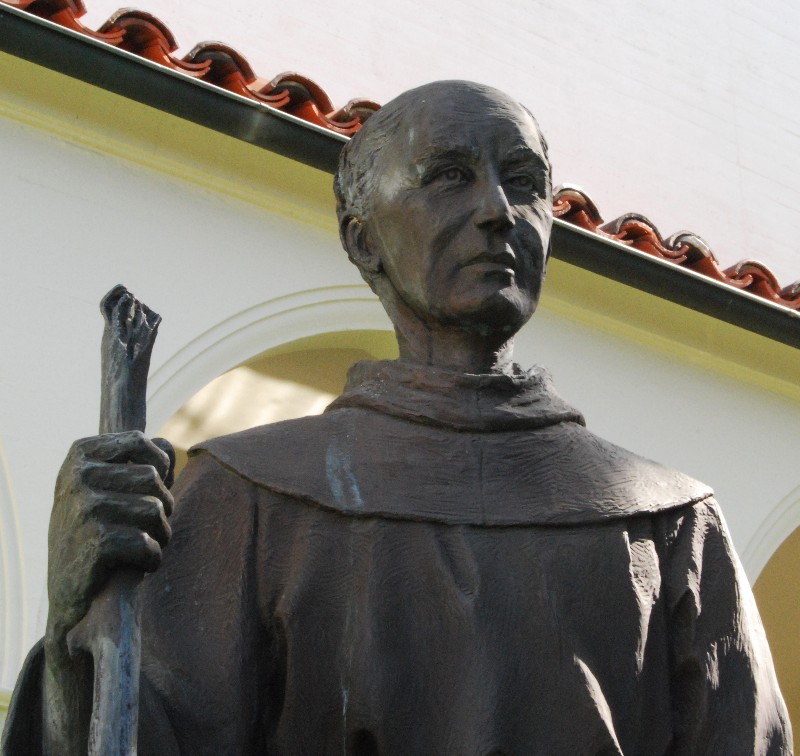
I began research for a longer piece on this subject.  As a precursor to my study, I reviewed my photographs over the last few years and I realized I have made it a point to collect images of statues whenever I visited a California Mission or a Catholic church.  Many of the images were quite startling in their graphic depictions, but a few were striking because of the facial features, especially the eyes.  I decided to publish some of these photos here on the blog in keeping with the season of Easter.  As I continue to research and write, I am sure there will be more to come about these haunting icons and their importance to Catholics the world over.