Friday, July 12, 2013

Summer School


One teacher sat outside on the breezeway running through math flashcards, challenging his primary grade students to solve the problems.  To his left was a whiteboard on an easel, should he need to explain something with a diagram.  His students were riveted to his lesson.

Across the playground, another primary teacher supervised her students as they completed exercises in a workbook, fat pencils in hand.  Again, students were absorbed in their work.

On another bench, middle school students were playing a variety of games, prepping for their upcoming high school entrance exams.  The mood was lighthearted and fun.


Summer and school are bad words, language most foul, at least to students who want their freedom from the classroom for the balmy-to-ferociously hot days of June, July, and August.  In recent years, school districts and private school boards have flirted with lengthening the school year, or even daring to suggest eliminating summer vacation altogether.  This receives a decidedly mixed reception.  Some parents scream that this keeps little Joey or Mary from having a proper vacation.  Others bemoan the lack of child care during those long summer days when they are stuck at work while the kids are at home creating havoc, and therefore, these parents welcome a full school year.  Students complain about every minute in the classroom no matter what’s going on, so the volume only increases when someone suggests more school during the hotter months.
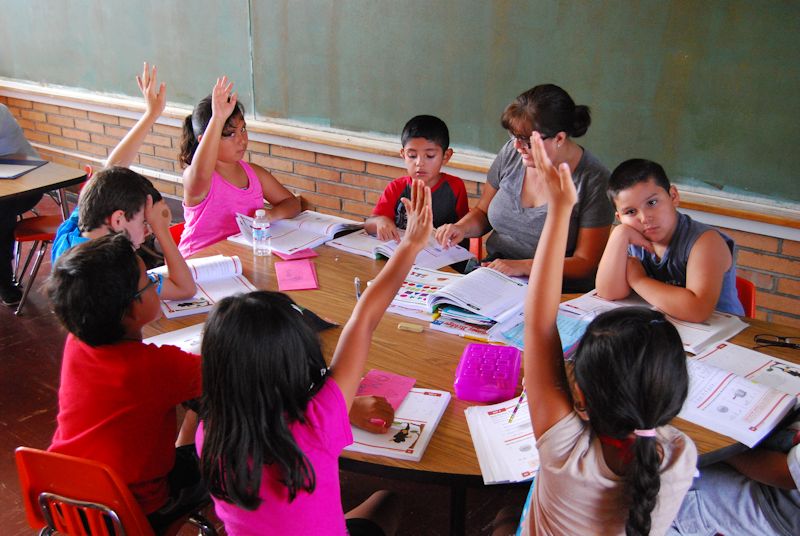

But really?  There is air conditioning.  And a break from school every summer is probably not in the best interest of students.

Summer school has traditionally been offered for deficient students who need to make up coursework.  Some programs also offer what are called enrichment courses.  A student wishing to excel and get ahead might enroll in such classes to pad the academic resume.

The students I observed were involved in what their school calls, “The Summer Bridge Program,” a way to keep skills sharp while also offering additional coursework to prepare for the next school year.  Teachers earn at least a little summer income—it is difficult to go three months without pay—and parents have a way to keep their kids busy while they are at work.  The students may complain initially, but on the day I observed, they were having a good time.  After the academics were over for the morning, the primary students played games involving physical exercise and lots of water from a hose.  Everyone screamed and shouted.  Middle school students made ice cream sundaes.


Summer school should be about exploration.  Students should have the chance to explore areas of the curriculum.  The emphasis might be projects that get students up and moving and following their own interests.  This might be the time to bring back shop classes.  Or, why not let students make their own films?  How about a three hour oil painting class?  Teachers should be challenged to come up with activities, not lessons.  This is the opportunity to set free the kinesthetic learner.  That is what impressed me about what I observed:  kids were moving.  They could shout, run, jump, freeze, roll, and dance as well as learn and explore.

We might even consider escaping the physical school building itself.  After a year of studying European history, is there a better way of cementing those lessons than a trip abroad to see the sights where history happened?  Summer is an excellent time to do an extended research project in biology for budding scientists.  I know of students on the college level who spend their summers doing just that, under the direction of a faculty member.  Others travel to Ghana to assist with building a water purification system to bring clean drinking water to local villages.  Still others travel to Nicaragua to work as medical assistants providing health care to rural populations.


This summer, I have been conducting writing workshops for incoming college freshmen.  All of my students are science majors, and most told me on the first days that they were not good writers.  I want them to feel comfortable with writing, so I let them be themselves on the page.  We focus on what is good in each student’s writing.  I use their awkward sentences and grammar problems anonymously to teach the class how to improve.  I help them understand how to write for an academic audience.  And I guide them into research.  Mainly, though, I want them to feel a sense of excitement, not dread, when they pick up a pen or open a laptop to write.  I don’t want them to fear writing.  There will be time for the full research paper, the endless textbook chapters, the long lectures and note-taking sessions come fall.


Summer school does not mean a loss of freedom.  It does not mean drudgery.  Summer school can involve ice cream, field trips, and running through the sprinklers with twenty-five of your best friends.  It is, however, necessary.  It should be a part of every summer.


Friday, July 5, 2013

The Sound of Summer Writing

Sky Lantern Festival, Taiwan


I’ve been hearing Ray Bradbury’s voice in my head this week as I teach my summer writing workshop.  It is not just that I use his New Yorker essay, “Take Me Home,” (June 4, 2012).  I will forever connect him to this most youthful of seasons because of his great story, “The Sound of Summer Running.”  Bradbury wrote amazing description and often his stories and essays read as prose poetry.  I would love to inspire my students to sink into the adjectival universe like he did, time after time, in every sentence he composed.

Check out this opening sentence, quite possibly the best ever written, from Bradbury’s short story, “Tomorrow’s Child”:  “He did not want to be the father of a small blue pyramid.”  If that doesn’t make you want to read on, you are not alive.

Or, how about this opening from “The Sound of Summer Running”:  “Late that night, going home from the show with his mother and father and his brother Tom, Douglas saw the tennis shoes in the bright store window.  He glanced quickly away, but his ankles were seized, his feet suspended, then rushed.  The earth spun; the shop awnings slammed their canvas wings overhead with the thrust of his body running.  His mother and father and brother walked quietly on both sides of him.  Douglas walked backward, watching the tennis shoes in the midnight window left behind.”

Those are some magical tennis shoes, and Douglas has quite an adventure ahead of him.

The essay I use with my students is a simple recollection of a special moment with his grandfather on long ago summer evenings when they launched fire balloons into the sky.  Bradbury creates not just a scene for us, but a lost world, all in a few sentences.  “While I remained earthbound, I would time-travel, listening to the grownups, who on warm nights gathered outside on the lawns and porches to talk and reminisce.  At the end of the Fourth of July, after the uncles had their cigars and philosophical discussions, and the aunts, nephews, and cousins had their ice-cream cones or lemonade, and we’d exhausted all the fireworks, it was the special time, the sad time, the time of beauty.  It was the time of the fire balloons.”

Bradbury evokes joy and sadness in the same moment, the way all of us look back on the best time of our lives.  His metaphor is the fire balloon, the tissue paper construction that is inflated by the warm air from a tiny box of fire hanging beneath it.  “Once the fire got going,” Bradbury writes, “the balloon whispered itself fat with the hot air rising inside…It floated up above the apple trees, over the beginning-to-sleep town, across the night among the stars.”

What I have already seen in my students, and what surprises me every year, is the often accidental beauty of their spontaneous prose.  We do a series of writing exercises to open each session.  I’ll ask them to write about a journey they have taken, or a special place they remember, or the moment when they realized they were grown up.  These are college freshmen on the cusp of a new chapter in their lives.  Almost all of them spoke another language first, not English, so when I hear their writing, I can tell they are thinking in one language and writing in another.  It is a struggle now, but being fluent in multiple languages in the future will help them have an advantage in the job market, especially here in the diverse cacophony of southern California.

The juxtaposition of languages leads them into some interesting constructions.  For instance, in English we say “I had a dream about my grandfather last night.”  Many of my students will write, “Last night, I dreamt with my grandfather.” Prepositions in English are odd words—their usage is based on context.  One can memorize a list of prepositions, as the nuns made me do back in elementary school, but in a given sentence, which preposition to use is not legislated.  Dreaming about someone or something is the standard construction.  To dream with someone is to do it in concert with another, as if you and your grandfather had the same dream at the same time.  However, I like the construct of I dreamt with my grandfather last night.  I think it sounds more poetic.

I also marvel at the wisdom of my students that comes through their writing subconsciously.  Many live in neighborhoods known for crime and violence, as well as poverty and desperation.  All of us have an image of a gang member, the picture portrayed so often in culture and the media.  These students know more than the abstraction; these gang members are their neighbors and sometimes their friends, lovers, brothers and sisters.  When I ask them to write about their neighborhoods, one said that she encounters gang members several times a day when she walks her dog.  “I just stare them down and say hi.  If you show fear, they’ll be on you in a minute.”

Another wrote about her neighborhood as a parallel universe to the one people see when they drive the streets.  “The crazy people hang out at the abandoned mental hospital, just living inside the empty buildings,” she writes.  “The homeless go to the park and live there.  My preschool is next to a cemetery.”  Her city is filled with the poetry of juxtaposition.

My students are also natural storytellers.  In their voices, I hear echoes of Sandra Cisneros’s The House On Mango Street, a classic text of the high school classroom.  In their writing, as fragmented and error-prone as it is in its raw form, I hear the voice of the places from which they have come, the neighborhoods, the countries, the languages.  My job in some ways is to remove such distinctions and teach them the conventions of “good writing,” of “academic writing.”  Yet, what makes their voices unique is the personal, and I hate losing that.

My plan is to teach them research techniques, formats, and structures.  I’ll prepare handouts and presentations on the parts of an essay, the construction of an academic paper.  But in these first days I want them to find a comfort zone with their writing.  I want them to gain confidence in sharing their words with others, and hopefully discover the power of story.  Writing is such a revealing and powerful art, and often academic composition drains the blood out of the page, leaving dry husks of words that convey only facts and regurgitated ideas.

Years ago when I was a struggling student like them, a teacher I admired summoned me outside into the hallway before class started.  He had given me a poor grade on my recent academic essay on Ernest Hemingway’s work.  At the time, I was deeply in love with being a novelist or short story writer.  I did not have time for the academic stuff.  To the teacher, I just said I wasn’t comfortable writing essays, something I laugh at now since the essay is my favorite form.  “All writing is writing,” he said.  “In an essay, you are still telling a story.  The story is your analysis, or what you found in your research.”

I want my students to include the personal, their unique take on the topic of the paper—history, science, or literature.  Good writing is good writing, whatever the subject.  So my goal in the next few weeks is to keep their natural inclination to tell a story, and bring in the concepts of academic and rhetorical composition.  In this brief summer of writing, if I can bring them to a point where they are prepared for the next four years of research and composition while avoiding the fear and dread that often accompanies picking up a pen or opening a laptop to begin a paper, I will be happy.  I do wonder, though, if I might do more good with my workshops by simply firing up students to write and setting them free to commit to the page whatever they choose.  By overburdening the process with endless rules and structures for academic writing, do we anchor students to the ground while they wish to float like Ray Bradbury’s fire balloons?  I want my students to soar into their writing lives, “all fired and bright, adrift above a dead sea,” as Bradbury wrote at the end of his essay.  I do not wish to stamp out the soulful poetry that comes so naturally from the fire of their lives.  That is the sound of summer writing, and it should be our only goal.