Thursday, September 10, 2020

Bits and Pieces

Photo courtesy of Brittany Hosea-Small / AFP

Enough already for 2020.

This morning, I looked out the kitchen window facing east to see the sun hanging on the horizon, a smoky orange orb floating in the haze of particulate ash diffusing the new dawn light.  It is fire season, but we are being told by climate scientists and state government that this is the new reality.  Climate change is upon us, and as a penance, we will struggle to breathe through the fires year-round as our dried-out trees, brush, and homes continue to burn.

Paradise, California, is in jeopardy again.  Two years on from the last inferno, fire officials are telling residents to be prepared for emergency evacuation.  In California, 250,000 acres have been burned; 64,000 have been evacuated; three people are dead.  Fire rages from the Mexican border to Oregon.  The sky in many places is blood red.  Smoking foundations and chimneys are what’s left of structures throughout the region.  Parks and recreation areas are closed.  Many of the campsites have been abandoned, with picnics still laid out on tables like our own version of Chernobyl.

In addition to climate change, stupidity and lightning helped ignite the flames.  Also, bark beetles have infested and killed thousands of trees.  With so much dry, dead fuel, the inferno is inevitable.  Human idiocy includes a “gender reveal” party where people ignited fireworks in the midst of a picnic area tinderbox, and the conflagration spread quickly over several acres.  That’s something to remember; did they get it on film?  The child will certainly enjoy knowing that at his party, his parents burned thousands of acres of wilderness to celebrate his gender.

Every news broadcast has the weather person show us the view of the smoke from space.  There it is, that tan-white smear covering California like rancid mayonnaise.  The fires impact air travel and flight paths.  CHP closes the major arteries up and down the state.  Meanwhile, people stay in their homes waiting for the signal to evacuate, and when it comes, highways are clogged with people fleeing the inferno.  Wildlife and domestic livestock stampede through the burning woods, embers falling and cascading around them.

Should we rebuild in those burn areas?  Are we tempting fate?  Paradise is burning, and so soon after the last scorching.  The earth has not healed yet, and now, the fires come again.  Is there a way to make forests less susceptible to fire?  Often, burning the dead debris on the ground in a forest allows new seeds to take root.  It can be a good thing, but not when it comes to homes and human habitation.

In the perfect storm of 2020, the pandemic rages on.  Scientists now believe the coronavirus arrived in California as early as December 22, 2019, when hospitals began seeing an uptick in respiratory infections.  The virus also profoundly affects the human brain in some survivors, causing headaches, confusion, and delirium.  As we learn from Bob Woodward’s book, Trump knew the virus was deadly and could be spread by air since January.  He knew, and he lied.  Is this surprising?  Years ago, Trump said that he could shoot someone on New York’s Fifth Avenue and get away with it.  He has killed almost 200,000 Americans, and as of this moment, does seem to have gotten away with it:  every night, new revelations, new damning evidence, new felonies and misdemeanors.  The Trump presidency goes on, and now, he is closing the gap with Joe Biden.  Four more years and we won’t be recognizable as America anymore.

There is no dearth of strange news.  Two planes landing at Los Angeles International Airport reported to the tower that they had passed a “guy in a jet pack” flying at 3,000 feet and ten miles from the airport.  The FBI is investigating.  Officials express some disbelief in the sightings given that a jet pack capable of propelling a human being that high would be very expensive and could not be owned by a private individual.

Like everything else over the last six months, we can only say how surreal this all is, scratch our heads, and wait for what tomorrow brings.


Tuesday, September 8, 2020

Sidewalking by David L. Ulin


To borrow from the Tao Te Ching, the Los Angeles that can be spoken of is not Los Angeles.  The city is an enigma going back to the days when English was the second language of everyone in the pueblo, or as they called it then, la ciudad de Nuestra Senora de los Angeles de Porciuncula.  David L. Ulin grapples with the city’s ghosts and history in his book, Sidewalking:  Coming To Terms With Los Angeles (University of California Press, 2015).

The author is a New York native who relocated to L.A. in the early 1990s.  Since that time, he has dedicated himself to studying his adoptive city not from a car, but on foot.  He is a dedicated walker in the city and a rider of public transportation.  In Los Angeles, Ulin walks to “pay attention, to see the streets, the buildings…to immerse [himself] in a world that might otherwise slip by.”  His efforts to come to terms with Los Angeles include history, culture, and imagination.  To him, walking the city is a “mechanism of narrative, of liberation…a way to find and maintain one’s place.”

One cannot discuss Los Angeles without talking about racism.  Most people in and out of L.A. know of the riots following the taped beating of Rodney King, but Ulin takes the city’s entire history of upheaval.  The Watts riots in 1965, the Zoot Suit riots in 1943, and the “housing covenants and miscegenation laws,” and on back to the Mexican-American War:  the city is steeped in unrest and violence.

There is much to consider when talking about historical Los Angeles and in the southwestern United States as a whole.  Ulin cites the treaty signed between General Pio Pico and John C. Fremont which ended hostilities between Mexico and the United States in 1847 as significant.  But not all history in L.A. is in the long past.  Ulin discusses the growth of mall culture, especially the Grove.  He spends a lot of time analyzing developer Rick Caruso, who built the Grove and several other projects in the city.  He is the master of the mixed-use property that includes both business and residential units.  Caruso has raised this kind of building to an art form, especially with his Glendale Americana at Brand and the Grove.

Caruso, who admires Walt Disney, describes how the Grove replicates his idea of Main Street U.S.A.  Yet, the area is tightly controlled.  There are rules and regulations that create a lack of spontaneity within its confines.  The Main Street is constructed for shopping, people watching, and fine dining.  Recently, the real streets encroached on this simulacrum when rioters, walking alongside those protesting the murder of George Floyd, gained entrance to the Grove and burned a kiosk and vandalized several stores before LAPD put an end to the rampage.  The Main Street at the Grove became part of every real street in America, and could not escape the anger of these times.

Ulin points out that we used to have streetcars in this city.  They were removed when California embraced the car culture, and only now are we talking about putting them back into service.  Caruso is again the catalyst for a system that would connect the neighborhood around the Grove with subway terminals and public transportation corridors.  Ulin makes an important point:  public transportation must be ubiquitous to fulfill its promise.  He attends a public hearing and shocks the audience by saying he wants a subway stop on his block.  He makes the point that only in Los Angeles must one drive to find a place to walk.  “Melrose Avenue, Venice Beach, Griffith Park, even the Third Street Promenade…all are served by lots and parking structures, as is, of course, the Grove.”

Ghosts haunt Ulin’s walks and forays in the city, and these sections are the strongest and most evocatively written.  All around, he sees change.  “This is the most obvious idea in the world,” he writes, “that time takes everything from us, that streets feel possessed by ghosts because they are possessed by ghosts, the ghosts of all the people who have ever traversed them, who have ever occupied those cubic feet of space.”  L.A. is a haunted city.

The term, Sidewalking, comes from the shops on Main Street where merchants could stand outside and welcome in pedestrians to their shops.  From this, Ulin takes his title.  It is all about community, commerce, and culture.  He digs deep into L.A.’s unique character, its quirky places and inhabitants, its history and darkness.  He concludes with poetry:  “What else is a city but a dream in three dimensions, inhabited by succeeding generations who create identity in the muscle memory of its streets?  What else is a city but an imaginatorium, where the surface, the public record, is constantly collapsing into the interior landscape, the streets as markers, territorial or otherwise, the building blocks, the triggers, of identity?  That is how cities develop, that is how they evolve.”  L.A. continues to challenge, to defy, to strive to escape its history while simultaneously embracing that history.  And David L. Ulin keeps walking.


Sunday, September 6, 2020

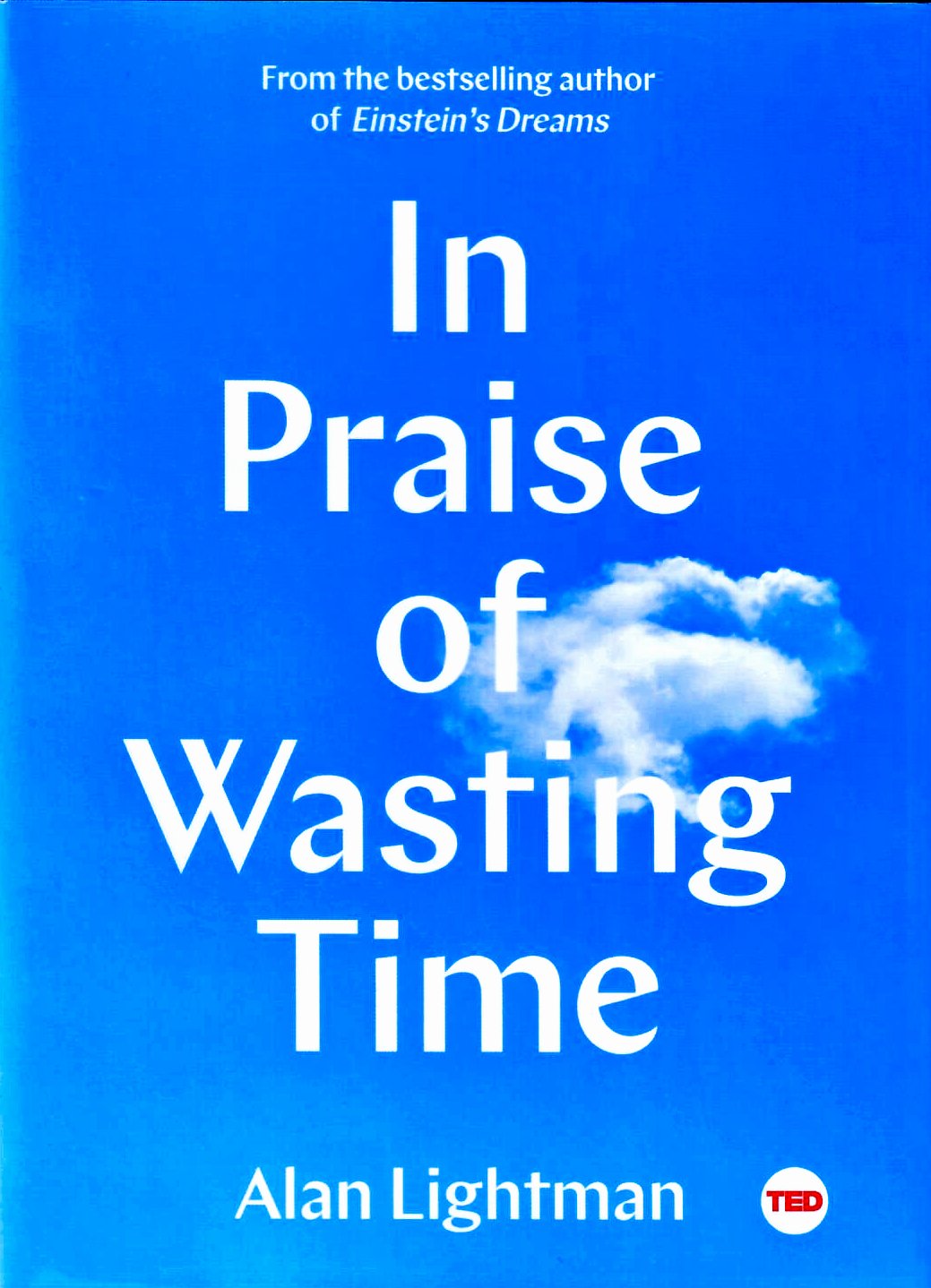
In Praise of Wasting Time by Alan Lightman


For several semesters now, I have become alarmed at the large number of college students who tell me they have panic disorders and chronic anxiety.  I feel for them.  Alan Lightman, in his book In Praise of Wasting Time (TED Books/Simon & Schuster, 2018), argues that in our lives today we simply have no time or space to process what’s happening and what’s demanded of us, much less learn difficult lessons and concepts.

Suffice to say everyone is stressed.  For college students, they have no time to digest material and fully comprehend its importance.  Lightman, a physicist and writer, blames our “wired world,” including the internet, social media, and the “frenzied pace and noise” of daily life with all its increased expectations.  He cites a Pew survey that found the average American teenager sends or receives more than 110 text messages a day.  Anecdotally, I have stepped on the college elevator and found every person tapping away or swiping on their phones:  an eerie quiet with only the tap, tap, tapping of fingers on a screen.

I often ask students about the obstacles to achievement in their college lives.  There are predictable culprits:  lack of preparation in high school; the difficulty of their course load; lack of time to study; working too many hours.  The surprise on the list, quite near the top of every survey, is loneliness, yet, we live in the communication age with smartphones that constantly keep us connected.  People, Lightman notes, take their laptops and iPads on vacation with them to check email.  Some students sleep with their phones on their chests, he says, and almost everyone keeps it within arm’s reach every minute of the day.  Yet, students fear feeling lonely.  Keeping the phone close by is one way to combat that loneliness.

On an academic level, students have never been taught to prioritize the information flooding through their devices.  Lightman says students desperately need better critical thinking skills to analyze how information fits into history, culture, and current events.  Students cannot think laterally; information comes in without connection to other areas or synthesis into thinking and writing.  It seems like no one is asking the question, how does what is learned connect to the larger picture?  What is the historical, human, social, or philosophical context?  This flood of information, this constant “breaking news,” only adds to the anxiety and uncertainty.

Lightman breaks down the kinds of thinking we need into two categories:  divergent and convergent thinking.  In the former, we have the “ability to explore many different avenues and solutions to a problem in a spontaneous and non-orderly fashion.  In convergent thinking, we have “the more logical and orderly step-by-step approach to the problem.”  Divergent thinking is critically essential to Lightman’s view that we need more time to analyze this flood of information and decide what is important.  We need time to breathe and time for silence and reflection.

I tell super-stressed students to plan their day with time for their studies and time for recreation.  Many are surprised to hear that, but I insist:  schedule time for recreation, to sit and stare off into space, and do not be intimidated by those who would call that wasting time.  Lightman has some insightful things to say about this, including that procrastination, the problem most identified by struggling students, might actually be beneficial.  It is only in the wired world that we must focus our attention on demand and take immediate action.  We cannot allow circumstances to bully us into leaping before carefully thinking through all considerations.

Lightman cites social psychologist Graham Wallas, who broke down the stages of creative thinking to:  preparation, incubation, illumination, and finally, verification.  This is also the way we learn.  We prepare by learning material; we allow the material to percolate in the brain; we come to a place of insight and understanding; and then we verify what we know through a test or evaluation.  This process takes time, and each student has a method that is unique to his or her character.  The way we study is dependent on how each of us learns.

Many students live with multiple people in the often small spaces they call home.  It is difficult to have a dedicated study space and have the time to think about what they are learning in silence and solitude.  Lightman advocates for the necessity of solitude as a condition critical to learning and understanding.  He says he has encountered many scientists in his field (physics) and artists (he is the author of the novel, Einstein’s Dreams, among other works), who “embrace solitude.”  They “practice their craft in solitude.  They draw strength from being alone…”  Students, then, should not fear loneliness.  It is a tool to enhance their studies and can be counterbalanced by scheduling time with friends or loved ones after periods of intense, solitary concentration.

Alan Lightman’s book has implications for how we live and learn.  The pace of our lives and the cascade of information we receive each day will never diminish.  What we can do is learn to slow down every moment and commit ourselves to a life of contemplation with periods of silence and solitude.  We can also leave our screens in other rooms and stare off into space as a critical method of thinking and learning.  Who knows what discoveries we will make while appearing to waste time.


Friday, September 4, 2020

Out Of Nowhere Into Nothing by Caryl Pagel

 Oh, what to make of this book!  The words gush out like an open fire hydrant.  Coincidences, strange occurrences, stories, historical events:  Caryl Pagel, in her book, Out Of Nowhere Into Nothing (FC2/The University of Alabama Press, 2020), links them all together into a seamless world of wonder.  Her prose is dense, full of elliptical clauses and turns of phrase.

For instance, this:  “It had been nearly five years since we’d moved to Ohio for my job, which had since proved a stable but frustrating obstacle to life outside an eighteenth-floor English department located in a towering Brutalist building with skinny sniper windows and the amusing lore of nineteenth-floor flooding and loose asbestos.”  Or this:  “Moving closer, I noticed thousands of multicolored perfect circles the size of a pinkie’s tip arranged in great piles onto unframed stretched canvases creating a liquid, jubilant, multitextured field suggestive, perhaps, of a shag rug, speckled wall, or foamy shoreside ocean swell.”  Most of the essays in this collection have no paragraphs; Pagel fires solid blocks of text at the reader filled with word-joy that is contagious.

The book blurs several lines.  It is memoir, critical analysis, history, literature, and cultural study.  Pagel begins with a mission statement going beyond changing names to protect the guilty.  “This book is interested in memory, accumulating particulars, and retelling a good story,” she writes on the copyright page.  “It is a work of nonfiction and fiction.  Though it includes research and aims for veracity, the narratives ultimately rely on the author’s version of events.  The author has been, and could still be, mistaken.”

Pagel’s style is a bit Joan Didion, with her cool distance and pile-driving prose.  The coincidences, the inexplicable events that seem so fateful, that is Pagel’s métier.   She manages to take the culture’s temperature and illuminate the connections.  In the essay “What Remains To Be Seen,” she blames human beings for environmental carnage.  “Even the deepest floors of the ocean had been tainted by toxic debris,” she writes, “grocery bags, pill bottles, straws, coffee holders, microbeads, tarps, tape, car parts, bottle caps, jacket fibers, carry-out containers, shoes, ghost nets, children’s toys, mattress stuffing, lost balloons, cutlery, shampoo bottles, pylons, oil jugs, and so on.”  It is a resounding indictment of the way we live and the human disregard for our ecosystem.  This results in turtles consuming soap, children with high levels of lead in their blood, opioids in mussels, and “evidence of Fukushima’s nuclear signature…in California wines.”  All of this, including several references to our current leadership, creates an end-of-the-world nightmare.

The most haunting discussion she offers is the unique dream she shares with a boyfriend.  She does not wake to share the dream with her sleeping companion; no, where her dream left off, her boyfriend’s dream began.  Only when they swap dreams in the morning do they realize what has happened.  She dreamed that she was ill with “a disease that caused deep coughs and a spiking fever, a tense chest and numb limbs, and that the diagnosis was fatal.”  In her dreamland, the boyfriend goes to the pharmacy for medicine, but Pagel fears he will be too late and she will die.  A voice disturbs the dream and she begins to awaken.  The voice is her boyfriend, mumbling, “What kind?”  She shakes off the fear ignited by the dream and goes back to sleep.  The next morning, her boyfriend tells her he had a strange dream where he was standing in an aisle at Walgreens, wondering what medicine to buy for her because she was sick.  Pagel calls this “plot transference,” and she remembers still the details of the shared dreaming.  She tells us the trouble begins when we cannot determine “where the dream begins and…waking life ends.”  She utilizes a refrain several times in the book:  “Are we inside or outside?  Are we small or far away.”  She takes us through several dream stories, including one with her somnambulist brother who once was discovered by their father “filling every concave object in our kitchen with tap water…both hard at work and sleeping.”

Pagel’s polymath tendencies make for interesting moments if cross-connection.  She analyzes the burgeoning nineteenth-century fascination with mediums and spiritualism involving investigations by the likes of William James.  She connects this interest to allowing women “to harness their perceptive intellectual authority in a somewhat public setting” inspired by the evolving suffrage movement.  She spends time unpacking and critically examining art and architecture in America.  She writes about photographer Vivian Maier as someone who snapped moments of contemplative thought on the streets of Chicago.  She captures the distractedness of the now:  “I admired the colors, the concept, the plot,” of a work of art, she tells us.  But she also touches her phone to check for new text messages.

Caryl Pagel pulls together a multiverse of stories, facts, photographs, art, and cultural nuances to illuminate the coincidences and accidents that create the scaffolding of our lives.  The final sentence of the book illustrates how we might look back at our lives upon reflection.  Pagel encounters a man at a hotel where she is staying, and they strike up a conversation.  “You know,” he says, “I’ll tell you something.  It was the strangest set of circumstances that brought me here…”  And yet another story begins.


Wednesday, September 2, 2020

The Book of Atlantis Black by Betsy Bonner

Some of us live our lives on the edge of the vortex.  It takes every ounce of strength to hang on and not be pulled into the abyss.  That is Betsy Bonner’s struggle in the story of her sister’s all-too-brief life and the black hole she left when she mysteriously disappeared in The Book of Atlantis Black:  The Search for a Sister Gone Missing (Tin House Books, 2020).

The memoir begins and ends with a body; the first is that of a young woman who may or may not be Eunice Anne Bonner, also known as Nancy, also known as Eunice Anne Black, also known as Eunice Atlantis Black.  She is found in a hotel room in Tijuana with Atlantis’s passport and California driver’s license.  The physical description does not match exactly; however, her mother believes it is Atlantis.  Mexican authorities cremated the body before a positive identification could be made with fingerprints or dental records.  The second body is that of the mother, herself a suicide with multiple drug toxicities in the final pages of this harrowing account.

Bonner must be lauded for drilling down into the depths of this story.  There are wounds beneath wounds here, scabbed over and painful, but she reveals herself to be a valiant and fearless writer.  This is a book about wreckage, about losing someone even while making every effort to hang on to them, to save them.  It is an unsolved mystery in that there is little closure here, if such a thing exists.  Most likely, based upon her mother’s reaction to seeing the body, it is Atlantis in the Tijuana morgue.  Hard living and dying render the dead unrecognizable.  Bonner writes that if it is not her sister, she has never surfaced.  She has never reached out.  The sisters had a pact to meet in front of the Mona Lisa at the Louvre in Paris should Atlantis’ numerous run-ins with the law ever force her to flee the country.  Bonner has no desire to go there after Atlantis disappears.  There has just been too much—too much pain, suffering, and exhaustion.

That is one of the things the reader feels the most in this memoir:  exhaustion.  One sees the impact on the family.  The Bonner household is not an easy one to inhabit:  a strict, Catholic father who beat his eldest daughter; a bipolar mother who is often drugged; and Betsy, who avoids her father’s hand and is often considered the older sister even though she is two years younger than Nancy, as she is called in childhood.  The adult Atlantis’ actions often reflect on the other family members, and they struggle to understand her mania.  Betsy is the achiever, the one who excels despite the conflagration at home.  She is left to pick up the pieces after their father dies, and her mother and Atlantis become more and more out of control.  Betsy tries to clean up the mess after Atlantis’ disappearance when the vultures circle trying to steal away her sister’s music rights and the few other assets she has at the time of her disappearance.  Her strength is epic.

Atlantis was a musician and performer.  She lived for her compositions and performances.  Bonner writes that she “believed that the demons possessing Atlantis would kill her if she didn’t perform.”  There is plenty of testimony to this in the book.  Atlantis’ music is still on YouTube; her song “Ophelia” is dark and foreboding with raspy vocals and droning guitar chords.  Her music is not easy to listen to, full of despair and the black dog of depression.

Chadds Ford, Pennsylvania, where the girls grew up, is also the home of painter Andrew Wyeth.  Bonner makes this connection early in the memoir.  Much of her imagery parallels Wyeth’s work, the bleak, stark country and its menacing, forlorn characters.  These are the faces of lonely people, eyes that look out with fear and wariness.  His brushstrokes highlight the banality, the frigid landscape of emptiness.  Atlantis seemed destined to escape this bleached country; both girls travel far in their lives to escape the muted context of small-town Pennsylvania.  There are numerous incidents and references to abuse—sexual, physical—by people who prey upon others, especially children.

All of these episodes, the manic behavior, the home life of instability, impact Atlantis and Betsy.  The value in such a bleak story is to tell it true, as Bonner so effectively does.  She does not cave to emotion.  She is clear-eyed in her details, many of which are hard to take in.  She asks the morgue for a lock of her sister’s hair and receives it with a piece of scalp still attached, already green with decomposition.

Betsy Bonner’s thesis comes at the very end of her memoir.  “I never tried to meet my sister at the Louvre,” she tells us, “because I knew she wouldn’t—couldn’t—be there.  And I also dreaded that she might actually show up.  If she were still alive in the year I write this, she’d be forty-two.  But she’ll be thirty-one forever,” her age at the time she disappeared.  Bonner goes on to deliver her epiphany in all of this:  “My own life has been shaped by what I inherited:  most of all, my sister’s story.  I’m still living off of her fortune.”  This is what it means to live life until all that remains are the stories we leave behind and the ashes of our annihilation.