Saturday, November 5, 2011
One Day I Will Write About This Place
It is always interesting to pick up literature originating in another culture and find echoes of our own. In that spirit, I was intrigued by Binyavanga Wainaina’s coming-of-age memoir, One Day I Will Write About This Place (Graywolf Press, 2011), set on another continent and within a completely different culture.
Wainaina writes about growing up in Kenya, the tensions among tribes and factions, his own mental breakdowns and inadequacies, and finally, his triumph upon finding his path in life centered on the twin suns of writing and literature. Even in his darkest moments, it is reading that saves him, and writing that allows him to capture the fertile decadence of his African life. Wainaina writes how he loses himself in literature, devouring books like a man steeped in hunger. This rabid reading habit comes at the expense of his social life and education. “I do not concentrate in class,” he says, “but I read everything I can touch.”
The echoes of American cultural influence come in the form of television. He cites cultural icons like the 1970s TV series, The Six Million Dollar Man, starring Lee Majors, reciting the show’s distinctive opening narration: “Steve. Austin. A me-aan brrely alive,” he writes in dialect. “Gennlemen, we can rebuild him. We have the tek-nalagee. We can build the world’s frrrrst bi-anic man.”
His experiences in Kenyan schools also echo American institutions. There are the tests that act as gateways to universities and higher education. There are the expectations of his parents that he will choose something lucrative, and their pressure on him to do something with his life. He struggles to find his own path.
In the first two-thirds of the book, Wainaina adopts a highly poetic, fragmentary style of writing. He mixes up descriptive words and sensory perceptions, making for some stunning prose. He speaks of his mother’s voice “like shards of water and streams of glass.” Examples of sound description include, “One bee does not sound like a swarm of bees. The world is divided into the sounds of onethings and the sounds of manythings. Water from the showerhead streaming onto a shampooed head is manything splinters of falling glass, ting ting ting.” He uses creative juxtapositions of adjectives and modifiers as well as interesting combinations and spellings of words.
His poetry is beautiful and effective especially when he writes of his reading life. He closes his eyes to the hot African sun, only to open them a few seconds later and return to his reading. “If I turn back to my book,” he writes, “the letters jumble for a moment, then they disappear into my head, and word-made flamingos are talking and wearing high heels, and I can run barefoot across China, and no beast can suck me in, for I can run and jump farther than they can.”
His language is mesmerizing, intricate, crystalline, simply beautiful. “Science is smaller than music, than the patterns of the body; the large confident world of sound and body gathers. If my mind and body are quickening, lagging behind is a rising anxiety of words.” He captures the rituals of the Catholic Church, which he says are “all about having to kneel and stand when everybody else kneels and stands, and crossing and singing with eyebrows up to show earnestness before God, and open-mouthed dignity to receive the bread.” By far the best line is the one where he assesses his fear of ending up as a school teacher, something he calls “A fate worse than country music.”
Occasionally, the language can be overdone, too obscure and obtuse for its own good. An example: “The sun is the deep yellow of a free-range egg, on the verge of bleeding its yolk all over the sky.” An egg does not “free-range,” only the hen laying it. I am not sure a supermarket egg might not be able to bleed the sky yellow just as competently.
Wainaina does not shy away from his more difficult moments: his breakdowns where he withdraws from everything, including his family, to hide away and read books, avoiding responsibilities or facing his own failures. These difficulties lead to statements of startling wisdom. “If there is a miracle in the idea of life,” he writes, “it is this: that we are able to exist for a time, in defiance of chaos.” He manages to get a handle on his “chaos” and emerge as a writer and journalist.
In the last third of the book, he shifts to a more concrete language as he struggles to write and publish. Noticeably, the tension increases. He realizes the purpose of his journey. “It often feels like an unbearable privilege—to write. I make a living from simply taking all those wonderful and horrible patterns in my past and making them new and strong. I know people better. Sometimes I want to stop writing because I can’t bear the idea that it may one day go away. Sometimes I feel I would rather stop, before it owns me completely. But I can’t stop.” The emotional peak comes when he returns to life and embraces family and country, no longer afraid of the dichotomy. It is then that he decides that “One day I will write about this place.”
The book is by turns moving, poetic, full of grace, tinged by anger and humor. Like the African art that adorns the cover, the book revels in the color, the bloodshed, the tribal conflicts that are so much a part of Africa today. Out of the heat and dust, we are indelibly marked by Binyavanga Wainaina’s poetic prose. His words are infinitely earthy, primordial, ethnic. Yet, his book is filled with a tragic, desperate beauty. His story is that of a young man developing a life of the mind while never truly escaping home.
Saturday, October 29, 2011
Personal Matters
I spend my days working with individual writers on papers for their college classes. For the most part, these papers are research-based analysis of topics within the disciplines of sociology, medicine, and psychology. I spend time reading through the essays, marking them up, correcting grammar and format, and making suggestions on how to bring out the strengths and minimize the weaknesses in the writer’s work. I have, however, learned to go easy on one aspect I always find missing from scientific research and analysis: the first person pronoun “I.” Most teachers do not allow the use of “I.” “You must be objective,” they tell the students. “Only the facts and your analysis.”
Some of the papers this semester focused on the film, Mysterious Skin (2004), a rather intense and graphic depiction of child sexual abuse and its effects on the lives of two boys. Many of the students found the film disturbing on many levels, and a few struggled to even write about it with any kind of depth or discussion, subconsciously trying to avoid confronting the horrific acts depicted in the film. The startling realization I came to when speaking with each writer is that many of them had experienced or witnessed some kind of abusive situation, either sexual, physical, or verbal, and the movie served to dredge up those memories and refresh the trauma.
When it came to writing an analysis, the students were asked to take on the case of the two leads and discuss how they would approach the situation as social workers. In their essays, the students were to write in third person—“a therapist should…”—and avoid reacting on a purely visceral, personal level. To show anger or any emotional reaction could make the patient shut down, or feel as if some kind of judgment was being rendered.
But here, I have a problem. I understand the need for an academic approach, an objective scientific stance when observing a case. However, as a writer, this goes against the grain. The personal is always important, even when it is subconscious.
A journalistic essay requires the who, what, where, when why, and how, the solid lead, the salient facts, the descriptive details. In true third person objective journalism, personal feelings about the events must be left out. Yet, is this practically possible? A writer can choose which facts to emphasize, which, in a way, can evoke emotions in the reader. Through an objective, carefully organized telling of the facts, the journalist can subtly influence the effect on the reader of the writing.
Readers of journalism are seeing the story through the writer’s eyes. It is the world “as seen by,” and even reaction to a film clip of a news event can be influenced by the editing of the tape. Often, journalists will say, “I want to be a fly on the wall, a neutral observer of the story.” By his very presence in the space, the journalist alters the scene.
Writing is a personal act. Even a “just-the-facts” rendering has strands of the personal buried in it, and the personal matters. If the writer removes herself from the page, if the writing is merely an academic exercise, readers will turn away. So, how does one bring in the personal, and how much “personal response” should be allowed onto the page before objectivity is corrupted?
Writers are entitled to an opinion if they have done the homework—read the text in question, read articles and research about the subject, witnessed the event, and/or thought about it and considered all points of view. Too many teachers tell students, “You have no right to an opinion. You need to listen to me because I am the expert, and you are only a”—insert here: child, amateur, etc.—and thus begins the “expert lecture” where students tune out and check their Facebook page while the sage on the stage drones on and on.
Good writers find a way to write from the personal to the world. A good personal essayist resonates with readers. The writing strikes a chord. A narcissist resonates only with himself. He whines and complains, but in the end, doesn’t give a shit about the rest of the world. He’s only interested in airing his grievances and showing how smart he is.
Joan Didion, one of my writing heroes, was taught that she was the least important person in the room, and she believes this role serves her well in her job as a journalist. It is okay to be unobtrusive, but a writer is always present. The writer’s eyes see the world for us. She is the witness. That is the success of the writing—the reader feels the experience as if he were present. That’s not narcissism; that’s good writing. Didion also insists that she writes to find out what she thinks. Writing is always about self-discovery. The additional obligation is to bend that revelation so that readers discover something as well. Good writing must resonate. That, in the end, is the only criteria that matters.
We are all on a journey—separate and together—and that journey has a finite end. We are singular in the way we live as part of the plurality. It is a paradox. Therefore, writing is not about the “me” or the “other.” It is the singular “I” or “eye.”
For example, the student writing about theories of hospice care for her nursing course should not avoid the experiences she had while interning as a hospice nurse. This could make for a fascinating essay as well. How can she bring in the “I,” (eye) to her research essay? It will take a bit of slight of hand, and a clever disguise, but her direct experiences with the theories in practice are too valuable to leave out. So, the writer must work to bring some of what she saw into the essay without compromising the third person objective research.
In the end, writing in a vacuum without the “I” (eye) is pounding sand. It is mental masturbation, the ultimate narcissism. It’s showing off. Sounds weird, doesn’t it? Leaving out the “I” can actually be narcissistic. But it is true. That kind of writing is stillborn, vapid, mere facts without context. Like a masturbatory experience, it has a beginning, middle and climax, but the writer still wakes up alone, bereft of the communal experience of being alive. In the end, it is the personal that fosters the connections to the readers. Good writing is the solitary tone that is universal, the sacred sound that resonates with all existence. In the end, it is the personal that matters most.
Monday, October 17, 2011
Selling (And Saving) Catholic Schools
According to Monsignor Charles Pope, writing from the Archdiocese of Washington this past summer, “over 6,000 [Catholic] schools have closed since 1970.”
Andy Smarick, in National Affairs (Issue Number 7, Spring, 2011) tells us that the decade of the 1970s saw 1,700 schools close. He goes on to say that Catholic schools are as American as George Washington, and were here before the Revolution began. In fact, he says, “these schools long pre-date the American founding.” The first Catholic school, started by Franciscans, opened in Florida, circa 1606. The Jesuits “founded a preparatory school for boys in Newton, Maryland” in 1677. “In the early 1800s, parochial schools—those affiliated with parishes—emerged and became the foundation for Catholic elementary schools.”
Across the country and around the world, millions of students have been educated in Catholic institutions. They have gone on to give back to the world as doctors, lawyers, artists, thinkers, and business leaders. A Catholic education is synonymous with higher test scores, greater achievement, and effective learning. And all of this was done on a shoe string budget, and with none of the bloated bureaucracy of public education. These teachers taught values, ethics, moral codes, as well as Latin, mathematics, literature, English grammar, government, history, biology, and all the sciences. Students graduated from Catholic high schools prepared for the rigors of college.
Today however, Catholic schools are in trouble. “Dwindling enrollment and other challenges have decimated urban Catholic schools nationwide…” writes Carla Rivera in the September 27, 2011 edition of the Los Angeles Times. The days of classrooms staffed by underpaid nuns are over. Now schools come with lay teaching faculty, men and women who must be paid a decent salary and receive basic benefits like health care and retirement. The cost per pupil is also on the rise. Education costs are climbing, and the reasonable tuition of most parish schools is not so reasonable anymore, especially if one or both parents are out of work, like many Americans across the country. There is competition from Charter schools and non-religious private institutions. So-called “helicopter parents” examine every facet of their child’s education, and are quick to jump ship if they think the school across town might offer the key to the Ivy League. So education is a competitive market, and Catholic schools can no longer afford to rest on their laurels.
So it is with that in mind that a crowd of Catholic school teachers, administrators, parents, and support staff gathered at Bishop Alemany High School in Los Angeles this past weekend to participate in a marketing think tank led by Dennis Polito and Caron Willits. The facilitators were part of a program called MAX LA, or Marketing Archdiocese Excellence in Los Angeles. These men and women who worked a long week teaching kids, grading papers, planning lessons, and running schools became Mad Men, marketing their schools in an effort to boost enrollment and grab the brass ring of financial stability.
Saturday’s topic was preschool outreach. How do we bring in more students? How do we keep the students we have? How do we get the word out about the quality education we offer? With a lot of energy and no cynicism, every school representative in the room focused on finding answers to these and other questions.
Participants willingly shared ideas and strategies: updated websites help, and teachers, even with all their other duties, should have class pages that are refreshed weekly with news items and pictures. Social media now plays a greater role: if a school is not on Facebook or Twitter, someone better get on it.
People who normally talk about books and papers and lesson plans spoke succinctly about “branding” and community outreach. Some spoke of unique and clever strategies to recruit students, like visiting local mommy hangouts and selling DVDs of school activities to parents in the hope that they will pass along copies to extended family members. Never under-estimate word-of-mouth.
One principal advised participants to make creative payment arrangements with parents who struggle financially. “Just get them in the door,” she urged. Some schools stay open during the holidays as a way of offering extended day care. Another principal said she opened the doors to her school at six in the morning and did not close them until six at night so children could stay until parents finished work. One school offered incentives to students to plan news-worthy events, and when the local channel sent a reporter, the kids got free dress.
The high point came when Archdiocese Chancellor of Schools, Sister Mary Elizabeth Galt, B.V.M., announced that for the first time in ten years, enrollment in diocese schools was up. “We were losing a thousand students a year,” she said. But the marketing efforts begun last year seemed to be making a difference. Sister then drew a name from a hat and sent one educator home with a $250 gift card to an office supply store.
In an age of failing schools and deep concerns about the future of American education, these participants were willing to devote weekends and additional hours to writing ad slogans, creating brochures, and formulating grant proposals. That is the new paradigm of teaching today, and even though a Catholic education has been the gold standard for decades and should need no huckstering to save a school from closure, teachers, administrators, parents and staff are more than willing to step to the plate and sell. It may be the only way to save their schools.
Logo courtesy of National Catholic Education Association website.
For additional articles about this subject, see the post here.
Saturday, October 1, 2011
Blue Mornings
This piece was written for the Daily News in Los Angeles on the occasion of the paper’s centennial.
I will never forget flying through the dawn. In many ways, those mornings in the eastern San Fernando Valley delivering the Daily News shaped my entire life.
I started my delivery service when the paper published on selected days of the week. By the end of my time, the Daily News was a seven-day-a-week publication with a unique valley slant. There were no mornings off for us carriers. I pedaled my ten-speed furiously through the neighborhood, racing the sun to get all my papers delivered and get back home to get ready for school. My salary helped pay for my Catholic school education and relieve the financial burden on my working class parents.
My daily journey was an adventure, fraught with a hint of danger and full of hidden secrets in the darkness.
There was the vicious mutt that stalked me. He ran loose in the neighborhood and would lie in wait to launch himself out of the dark shrubbery to attack me with gleaming fangs and horrible snarl. His teeth nipped at my frantic legs, and once he had a hold of my jean cuff, he tried to tear me off my bike. As a twelve year old who had just read about Sherlock Holmes and The Hound of the Baskervilles, I feared being torn apart by this beast. In a last ditch effort to survive, I loaded a plastic squirt gun with ammonia, and when the dog leaped at me the next morning, I managed to nail him in the face. He slid away into the darkness, never to harass me again.
There was the body on the sidewalk. I nearly ran over him and thought he was dead. Staring down at him, my chest heaving, I heard him moan and realized, as my nose registered the stench, that he was only drunk.
There were the mishaps, mostly due to my bad aim and weak throwing arm. The guy who demanded his paper on his porch or he wouldn’t pay me received a slamming wake-up call every 5 AM as I furiously hurled his paper against his screen door. Until I developed some skill, papers landed on roofs, in flower beds, and one time, through an open window with a crash of broken dishes and who knows what else.
Little did I know, when I returned home smeared with ink and smelling of newsprint, those days of delivery, in rain, cold, heat, and dust would lead me to a life centered on words as a writer and English teacher. But they did, and I would not trade the memories for anything.
I’d like to think that somewhere in another dimension of time and space, that twelve year old boy is still pedaling his way through another blue morning. In that place, people still read newspapers, children feel safe at school and on the streets of their neighborhoods, and a child flies through the dawn’s early light, launching a bundle of newsprint through the air to land on the front porch to inform the world.
Photo: Getty Images
Saturday, September 24, 2011
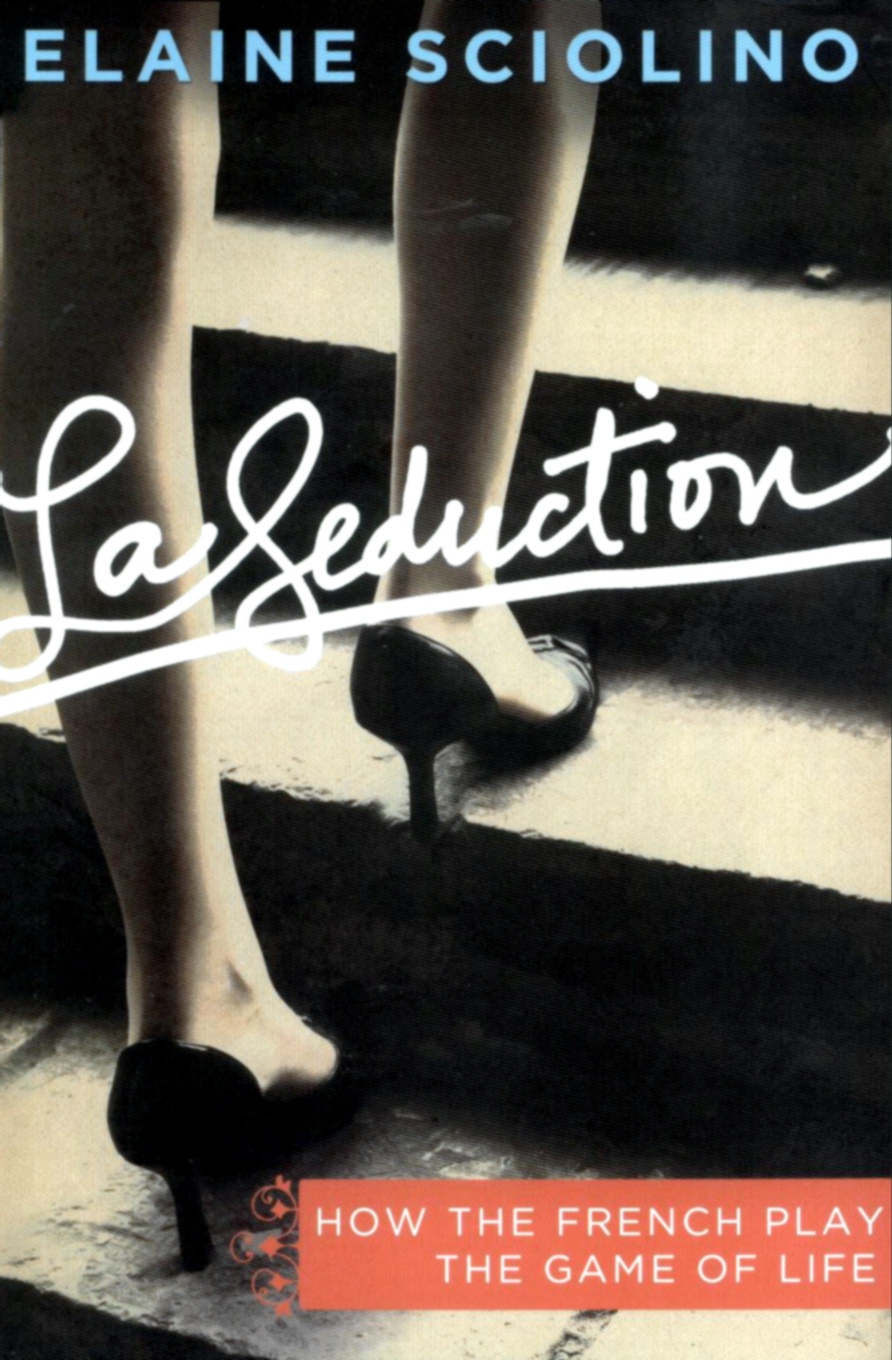
La Seduction
Americans have their stereotypical views of the French, which is why every American should read Elaine Sciolino’s book, La Seduction: How The French Play The Game Of Life (Times Books/Henry Holt and Co., 2011).
Sciolino is the former Paris bureau chief for The New York Times and was once a foreign correspondent for Newsweek. Currently, she lives in Paris with her husband, an American lawyer who practices with a French law firm.
Her goal in the book is to examine the way seduction is an integral component of French culture and behavior. She begins with the custom of the male kissing the hand of a woman to whom he has been introduced. The kiss is not romantic or passionate; it is offered like Americans offer each other their hands in greeting, but it is intimate and unique to French custom. It is all part of the way France integrates the fine art of seduction into every day life.
“In English,” Sciolino writes, “‘seduce’ has a negative and exclusively sexual feel; in French, the meaning is broader. The French use ‘seduce’ where the British and Americans might use ‘charm’ or ‘attract’ or ‘engage’ or ‘entertain’…The term might refer to someone who never fails to persuade others to his point of view. He might be gifted at caressing with words, at drawing people close with a look, at forging alliances with flawless logic.”
France remains an enigma for many Americans. This was never more clear than in the days leading to the wars in Afghanistan and Iraq, which France opposed. French President Jacques Chirac saw his country’s approval rating in the U.S. fall from 80 percent to 30 percent. “French products were boycotted,” Sciolino writes. “French wine was poured down kitchen sinks. Vacations to France were canceled. French fries became ‘freedom fries’ in the House of Representatives’ cafeteria.” Sciolino characterizes the incident as “the most serious diplomatic crisis between the two countries in nearly a half century.”
In France, philosophers appear on television and enjoy the status of rock stars. The country vigorously embraces a café culture, of thought over action, and the life of the mind is prized far more than physical effort.
Arguably, France has one of the most distinct cultures on the globe. However, some might argue that it is in decline. Sciolino believes this as well. “And yet the French still imbue everything they do with a deep affection for sensuality, subtlety, mystery, and play,” she writes. “Even as their traditional influence in the world shrinks, they soldier on. In every arena of life they are determined to stave off the onslaught of decline and despair. They are devoted to the pursuit of pleasure and the need to be artful, exquisite, witty, and sensuous, all skills in the centuries-old game called seduction.”
Emblematic of the need for seduction in every day life is the palace at Versailles, to which Sciolino devotes a chapter. She calls the wondrous chateau “France’s national monument—to love and to power.” She interviews a gardener there who wrote a book about the palace which included such details as: “the famous actress who loved to visit there to expose herself; the older politician who had sex in the garden with a young woman whom he had tied to a tree; the elderly couple who complained when one of [the] gardeners fell from a tree, landing on them as they were in the throes of lovemaking.”
She devotes a chapter to the magic of the Eiffel Tower, explaining the complex method of repainting the monument every seven years. To complete the job takes sixty tons of paint. The color formula is a state secret, but Sciolino learns that there are subtle differences in shade moving up the tower: light color on the bottom moving to darker tones at the top to create an optical illusion of a uniform look.
What baffles most Americans, however, is the behavior of the French. “For the French,” Sciolino says, “life is rarely about simply reaching the goal. It is about the leisurely art of pursuing it and persuading others to join in.” America is a land of finished projects, of goals realized. At the end of the day, we want to see accomplishment, whereas the French are content to let it ride, especially in appreciation of the journey.
Sciolino believes that as deep as the work ethic is embedded in American culture, the life of the mind is imperative to the French. She writes, “France’s history and literature reflect centuries of crafting ideas and intellectual concepts. The French have long pushed to persuade the rest of the world to consider and even adopt them. Modern philosophy originated in France, with Descartes. The eighteenth-century French philosophes—Voltaire, Montesquieu, Rousseau, Diderot—forged a set of values for society that gave preeminence to reason, democracy, and freedom. In the twentieth century, existentialism bloomed with Jean-Paul Sartre, Albert Camus, and Simone de Beauvoir.” France cannot escape its mind-life anymore than America can abandon its obsession with achieving goals and objectives.
Tourists, especially, have differing reactions to the French and their culture. Both men and women in France are expected to please each other on the street—men by verbally complimenting a woman for her beauty, and women by receiving the compliment and enjoying the attention. On American streets, this is tantamount to sexual harassment, the wolf whistle of the working man to the unfortunate beautiful woman pedestrian who happens by the job site. Americans are put off by French behavior. The confusion, says Sciolino, has to do with a smile. “Smiling is complicated in France. Americans are accustomed to smiling at strangers; the French—particularly Parisians—are not. This helps explain why some Americans find Parisians rude.”
By far, the most interesting chapters in the book are the ones devoted to hallmarks of French culture with which the world is so familiar: perfume and cuisine. Sciolino delves into the importance of scent to Parisians especially, giving us a history of the industry. She tells us that perfume has been used in France since Cro-Magnon days, when men rubbed themselves with mint and lemon to remove the taint of body and wild game. In interviews with French perfumers, she finds that Americans value scents of cleanliness and power, meaning deodorant and perfume that can be detected from several feet away. The French, she says, are more subtle and mysterious with their pleasant odors. And food is an orgasmic experience, she writes, full of subtle tastes and textures. The French raise the work of the vine and the labors at the stove to an art form, and tourists should close their eyes and surrender to the experience.
Sciolino also takes us through the gallery of French presidents, explaining how each managed to seduce the world, and where they tripped up in their efforts. Nicholas Sarkozy comes off as one of the worst in history. She brands him as “unskilled as a seducer in the classic French mode.” He is “frank rather than indirect, prone to naked flattery and insults rather than subtle wooing, perpetually in motion rather than taking time for la plaisir. He is contemptuous rather than enamored of the complicated codes of politesse.” He “contracts his words and salts his sentences with rough slang. In a country where food and wine are essential to the national identity, he prefers snack gobbling to meal savoring.”
The book ends with a grand salon dinner party, a fitting finale to a book so connected to good food and seductive culture. In the preparation for the event, we learn that French apartments come with bare kitchens, often with only a water source and maybe a sink. It is custom that the new tenants will install their own fixtures, appliances, and cabinetry. Then there are the rules of etiquette for the dinner party itself. I’ll save a little something for the reader to discover, but let’s just say that the biblical Ten Commandments are positively spare in comparison.
Elaine Sciolino has given us a veritable treat, a meal in itself, in her book. French culture still has much to reveal to the rest of the world, and in an age of global connectedness, it serves us well to be handed such an intricate and intimate study of a country once a super power, but now more of a philosophical influence on the rest of the world. It is not our similarities with the French that should be stressed, but that culture’s uniqueness which should fascinate and intrigue us. France, like a good meal, always surprises, always delights, and Elaine Sciolino prepares a banquet for us, with the depth and nuance of the journalist’s eye on the world.
Friday, September 16, 2011
Rage (And Hope) Against The Dying Of The Light
For a week now, I’ve been trying to write something about 9-11 and the last decade. Perspective eludes me; optimism is hidden in the darkness; disappointment and frustration have been my companions. The more I think about that day, watch the replays and tributes at Ground Zero, hear the personal stories of the victims and survivors, I am filled with rage.
When Osama bin Laden was killed, I was uncomfortable with the celebrations on the streets of America over the death. I felt it was crass and jingoistic. Then, I heard a Port Authority police officer speak on television last week of spending days digging, sometimes with bare hands, his colleagues out of the rubble, uncovering their broken bodies piece by piece so they could be returned to their families for burial. He said bin Laden’s death was most definitely a moment to celebrate. In his telling, I made the journey with him; I, too, saw the necessity of celebrating the vanquishing of this enemy. I am deeply conflicted between my unbridled rage and my better nature, and some days, I think rage is winning.
By the time I arrived in my classroom on that day ten years ago, the towers were down and the Pentagon was on fire. The world had literally and decisively changed on our thirty minute drive to work. In the classroom, even before the first bell, several seniors were in my face. I wasn’t supposed to see them until third period, mid-morning.
“Mr. Martin, you have to postpone the test today,” said their leader, a girl who normally slept through class.
“Why?”
“Because the World Trade Center was hit,” she yelled at me, as if the logic of her demand was so obviously rational. She smirked. “You can’t give us the test because we’re too traumatized.” At this point the dean came over the loudspeaker and decreed that all tests, quizzes, and homework were indeed cancelled for the day.
Later in the day, I stood watching a television with some faculty and staff members. The image on the screen was one of Palestinians dancing in the streets over news of the attacks. “This is what the United States gets for the way they’ve treated Arabs and Palestinians all these years in support of Israel,” a staff member said. “America deserves this.”
I turned to face him. “Don’t forget where you live,” I said. “They attacked your country, and like it or not, you’re an American. If you were on one of those planes, or in one of those buildings, none of those hijackers would have given a shit if you agreed or disagreed with your government. They would have killed you just because you’re American.”
When the news broke many months later that we had invaded Iraq under a veil of lies and deception regarding weapons of mass destruction, a student in one of my classes said he did not feel sorry for American soldiers who gave their lives in the war. “They knew what they were getting into when they signed up. Being lied to comes with the job.”
At the close of the decade, where do we stand? The wars have bankrupted us. More people live at poverty level, unemployment stands at almost ten percent, our children sit idle in our schools, our culture rots from the inside as we gorge ourselves on fast food, reality television and celebrity gossip while the sun sets on the empire. We are bereft of leaders and ideas, mired in the muck of our entropy.
Sometimes, though, we get a glimpse of hope in the eyes of a child.
This year, a young man in my wife’s English class, barely a teenager, wrote an essay about his hopes and dreams for the coming year, and for the future. His essay was written as a meditation on the themes of S.E. Hinton’s novel, The Outsiders.
“I have achieved a lot throughout my life,” he begins, “but what I am most proud of is placing 1st in the spelling bee when in 1st grade. I am also proud of being on the [academic] decathlon team, having an undefeated season with the school soccer team, winning track races, and participating in all kinds of sports. Although I have achieved a lot, I still need improvement…” He also speaks of the need to strengthen his “work ethic,” the desire to be more responsible, and more neat. These are his goals for this year. Long term, he says, his “life long dream is to have my own house, with a good paying job that I enjoy, and a family that I can share my happiness and memories with.”
He closed his paper with the words of Robert W. Service, poet of the Yukon, and his poem “Success”:
"The haply seek some humble hearth,
Quite poor in goods yet rich in mirth,
And see a man of common clay
Watching his little ones at play;
A laughing fellow full of cheer,
Health, strength and faith that mocks at fear;
Who for his happiness relies
On joys he lights in other eyes;
He loves his home and envies none. . . .
Who happier beneath the sun?"
Sometimes we must put down our rage and look to the far horizon. We must, against our darkest hours, realize the smallest joys, the mysteries of love, the comfort of friends and family. In the midst of ignorance, cynicism, cruelty, and dissembling, we must embrace hope. There is no closure, no solace in our tragedy; there is only one tentative, yet brave step, into the future.
I have written previously about 9-11. You can access that piece here.
Thursday, September 1, 2011
A Listening Thing
Some time ago, as winter slipped away into spring, William Michaelian asked if I would interview him for the tenth anniversary edition of his novel, A Listening Thing (Cosmopsis Books, 2011).
William is a force to be reckoned with, a great, eccentric ball of energy who publishes his writing and art in book form and on the internet. He blogs every day at Recently Banned Literature.
Our friendship goes back to the early days of The Teacher’s View when William contacted me about my review of Aram Saroyan’s poetry. He has become a source of wisdom in my life, and simply through our discussions, he has made me a better human being. Reluctantly, I must share him with a myriad of readers, writers, and artists around the globe who have discovered William’s incredible work as well as his deeply soulful insights into life and the human condition. I consider his friendship a blessing, pure and simple.
He sent me copies of his books and I found his writing riveting and beautiful. My favorite of his published works is The Painting of You (Author’s Press Series Volume I, 2009), a collection of poems, essays, and literary fragments detailing his mother’s descent into Alzheimer’s Disease. The book serves as William’s account of his round-the-clock care of her and his meditation on the fragile, often ephemeral joy and sadness of this life. In the tragic loss of a parent’s mental stability, one might not expect to find optimism and beauty, but it is there on every page, giving us as much a celebration of what was as an elegy for what is passing away.
It is difficult to pick favorites with William’s work. It is an embarrassment of riches. However, when he sent me one of his collector’s copies of the galley proof of A Listening Thing, I knew I’d found a classic. I was shocked to learn the history of his novel, the almost publication, the bankrupt publisher, acclaim so close yet so far. But what a book, indeed.
As I enter mid-life and realize there are fewer days ahead than there are behind, I find deep resonance with Stephen Monroe, the central character of A Listening Thing: regrets, mistakes, and like all of William’s work, a profound sense of the beauty of life and the hope intrinsic in each new year, each new day. The book is wise and sad and joyful like its creator.
I am also proud to have been offered the chance to co-author the interview William and Cosmopsis Books included in this new edition. My goal in taking on the assignment was to get out of William’s way and let him tell his story. I wanted to observe literary journalist Joan Didion’s rule to be the “least important person in the room.” I sent William a set of questions. He refined, sharpened, and then answered them. I followed up and offered a few additional topics. William shaped and integrated the material together. When I came to write the introduction to the finished interview, I nearly quit my writing career then and there. What could I say to match William’s words and his novel? I felt his hand on my shoulder. Just write, I heard him say. Words have never failed me, and they remained true on this project as well. The finished piece is included along with some new words from William. And of course, Stephen Monroe’s story is complete in this authorized print edition.
Fiction has the power to create a make believe world that resonates in our reality. William himself has often posed the question, what is real and what is dream life, and he has taken the opportunity in many of his works to explore the nature of reality, to push against the often blurry line between what is real and imagined. A Listening Thing will bring you into the fictional world of Stephen Monroe’s interior monologue, but it is ourselves we will find on the page. I invite you to embark on a journey, and like Odysseus returning, you will come to know yourself a little better upon reaching the end of Stephen’s story. In reading William’s work, that is the promise and the treasure.
For a complete list of William Michaelian's books in print, go to his website here.
Subscribe to:
Posts (Atom)